

Technology & Cybersecurity | 23rd November 2026
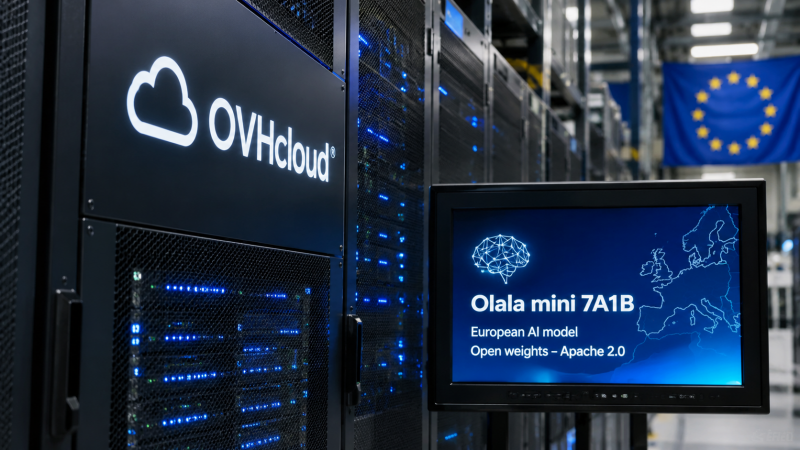
French technology company OVHcloud has launched Olala mini 7A1B, a new artificial intelligence language model developed and trained in Europe, marking another step towards greater European independence in AI technology.
Announced on 17th November and formally launched at the OVHcloud AI Summit on 19th November, Olala is the company's first family of large language models.
Unlike proprietary AI systems that require access to a commercial provider, Olala mini has been released with downloadable model weights under the Apache 2.0 licence, allowing developers and organisations to operate the technology on their own infrastructure.
Developed and Trained in Europe
The model was developed in France and trained using three European supercomputers: JUPITER in Germany, MeluXina in Luxembourg and Jean Zay in France.
According to OVHcloud, the training benefited from approximately €7 million worth of publicly supported computing resources.
Olala mini contains approximately 6.8 billion parameters, although only around one billion are activated during processing. This architecture is intended to reduce computing requirements while maintaining useful performance.
The company says the model can operate on relatively modest hardware, including compatible laptops, although local installation currently requires specialist software.
European AI Independence
The release is significant for Europe's efforts to reduce dependence on American technology companies.
European organisations increasingly face questions about who controls their software, where information is processed and which foreign jurisdictions may apply to their technology providers.
Because Olala's model weights are publicly available, organisations can deploy the system locally or on infrastructure of their choosing, potentially avoiding the need to send sensitive prompts to an external AI service.
Already Being Used by Qwant
French search engine Qwant has already adopted Olala mini for its rapid-answer feature.
OVHcloud reports that the model has improved response times by 20% while reducing operating costs to approximately one-third of the previous system's costs.
These figures are company-reported and have not been independently verified.
The model supports multilingual conversations, reasoning and software-assisted tasks. OVHcloud has also released specialised versions for document summarisation and translation.
Future Development
OVHcloud plans to expand the model family with improved reasoning capabilities, a larger context window and specialised applications for business software, cloud operations and cybersecurity.
These developments remain planned rather than currently available capabilities.
Olala mini is not yet a straightforward replacement for established consumer AI assistants. Its unusual architecture requires modified inference software, and its practical performance will depend on the intended application.
Nevertheless, the release demonstrates that European companies can develop and distribute their own AI models, supported by European computing infrastructure and licences that allow independent deployment.
For organisations seeking greater control over their technology and data, that represents a meaningful development in Europe's growing AI ecosystem.