

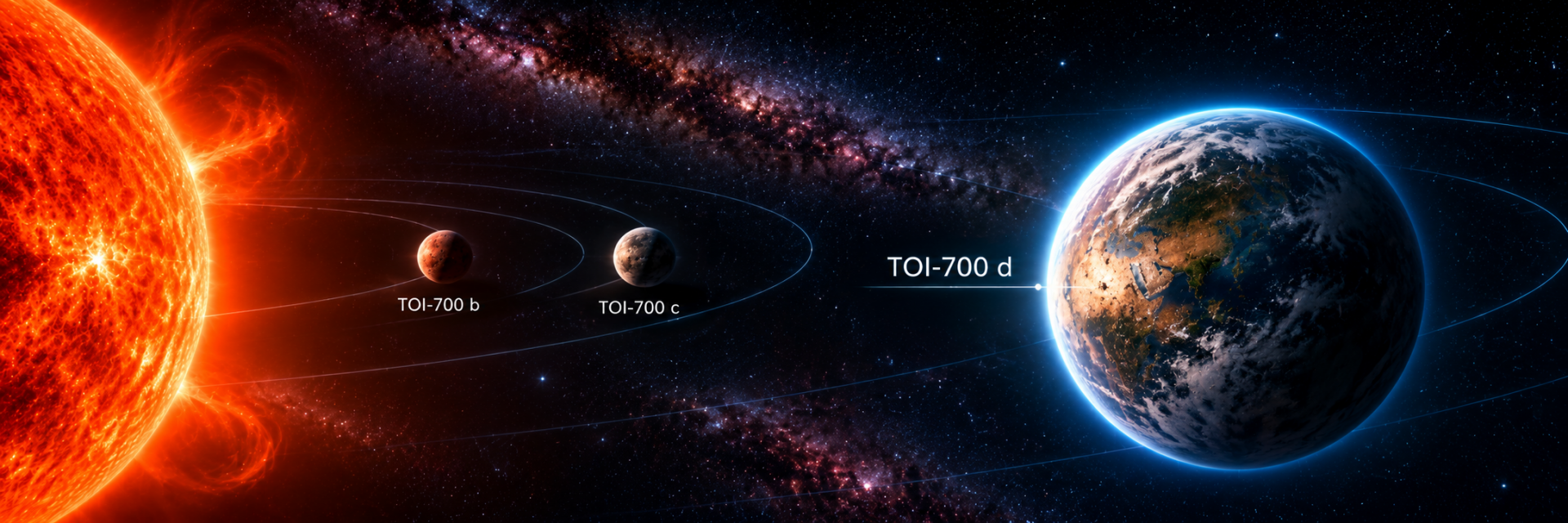
TOI-700 d
TOI-700 d — An Earth-Sized World in the Habitable Zone
Located approximately 101 light-years from Earth in the constellation Dorado, TOI-700 d is a potentially rocky exoplanet orbiting a small red dwarf star. Discovered in 2020, it became the first Earth-sized planet within a star's habitable zone identified by NASA's Transiting Exoplanet Survey Satellite (TESS).
The planet is approximately 1.15 times Earth's radius and receives around 85% of the stellar energy Earth receives from the Sun.
Its location makes it a promising candidate for investigating whether rocky planets around red dwarf stars can maintain atmospheres, liquid water and potentially life-supporting environments.
The TOI-700 Planetary System
TOI-700 is an M-type red dwarf star approximately 101 light-years away. It has around 42% of the Sun's mass and is considerably cooler and less luminous.
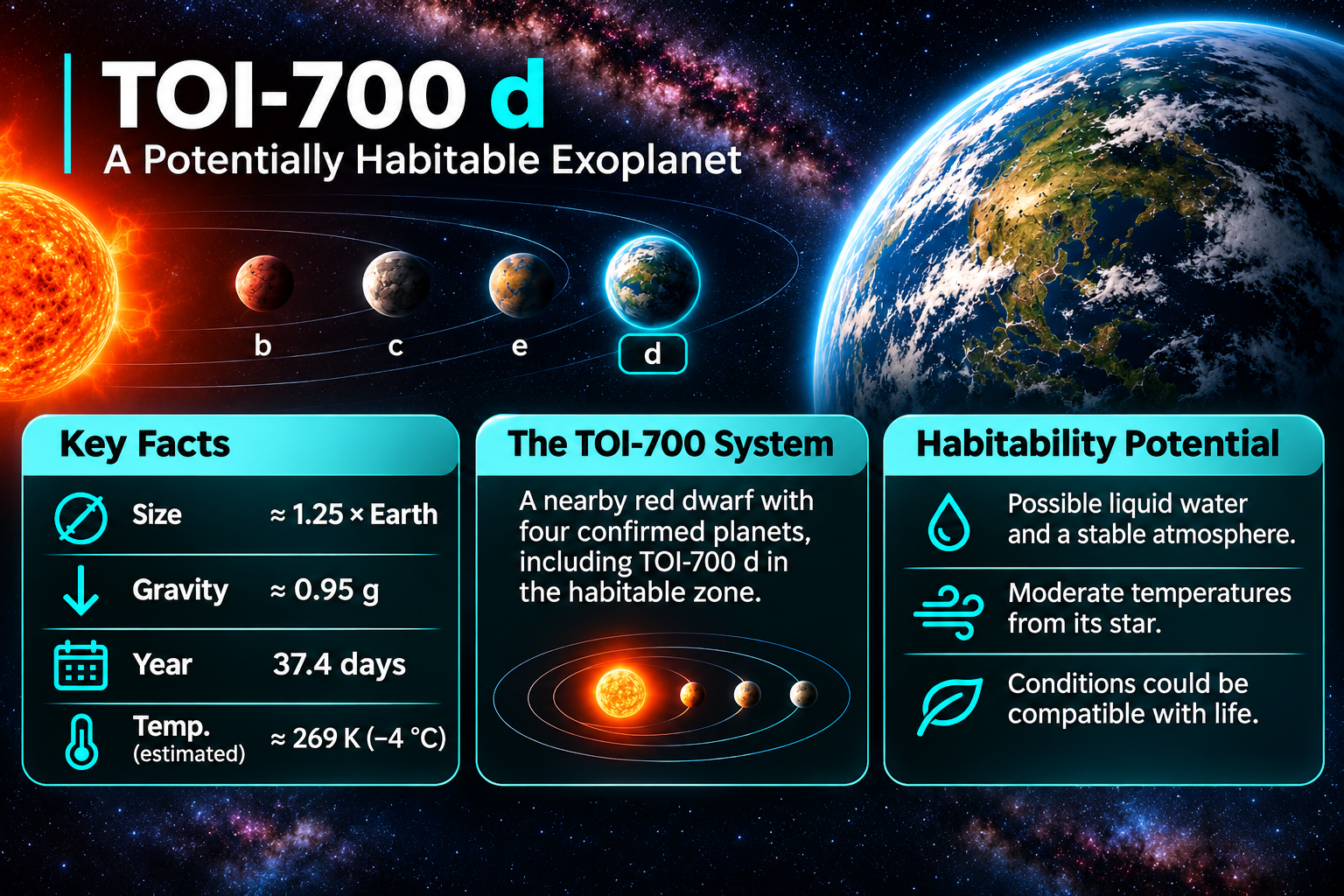
Four planets have been confirmed orbiting the star:
🔍 Click image to enlarge
-
TOI-700 b: An approximately Earth-sized inner planet completing an orbit every 10 days.
-
TOI-700 c: A larger planet, approximately 2.5 times Earth's radius, orbiting every 16 days.
-
TOI-700 e: A likely rocky, Earth-sized planet orbiting within the habitable zone every 27.8 days.
-
TOI-700 d: The outermost confirmed planet, completing an orbit every 37.4 days.
TOI-700 d and TOI-700 e are particularly interesting because both occupy regions where suitable atmospheric conditions could permit liquid water.
The star has exhibited relatively low levels of activity in observations, potentially providing a more favourable environment for atmospheric retention than some highly active red dwarfs.
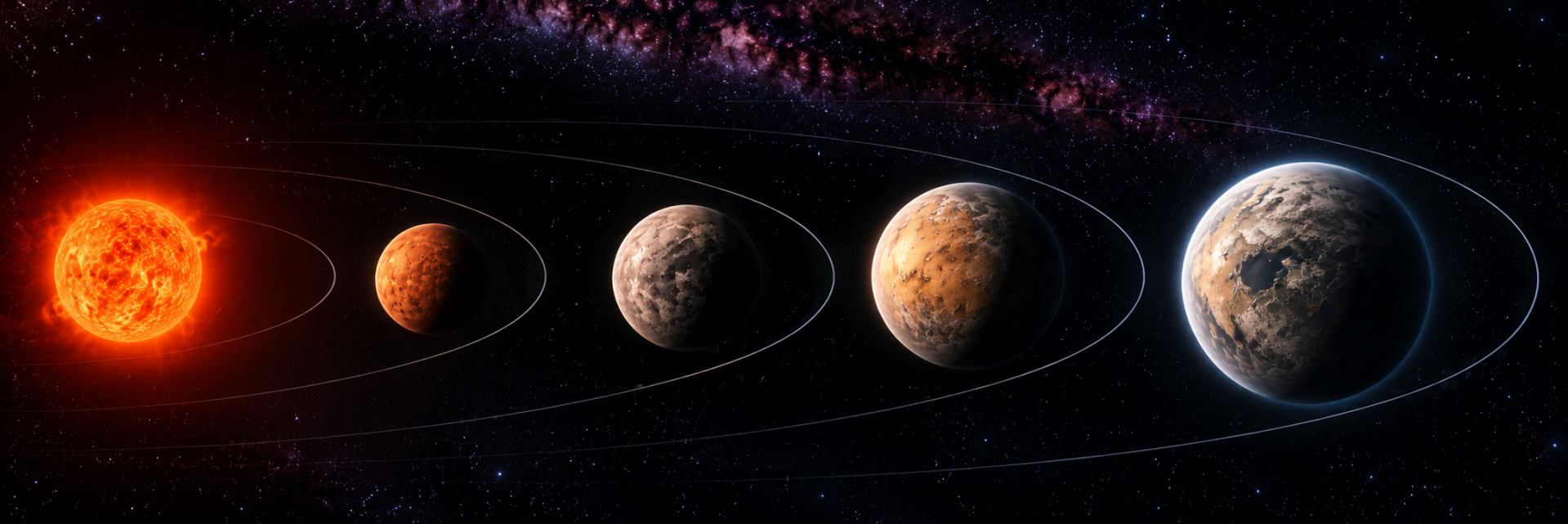
The TOI-700 Planetary System (artist's impression).
The Discovery of TOI-700 d
TOI-700 d was announced in January 2020 following observations by NASA's TESS spacecraft.
TESS identifies exoplanets using the transit method, measuring small reductions in a star's brightness when an orbiting planet passes in front of it.
Initial observations revealed three planets orbiting TOI-700. Scientists subsequently refined their understanding of the star's size and temperature, establishing that TOI-700 d was approximately Earth-sized and located within the conservative habitable zone.
Additional observations by NASA's Spitzer Space Telescope independently confirmed the planet's transit signal.
In January 2023, researchers announced a fourth planet, TOI-700 e, providing another potentially rocky world for comparative habitability research.
Size, Mass and Physical Characteristics
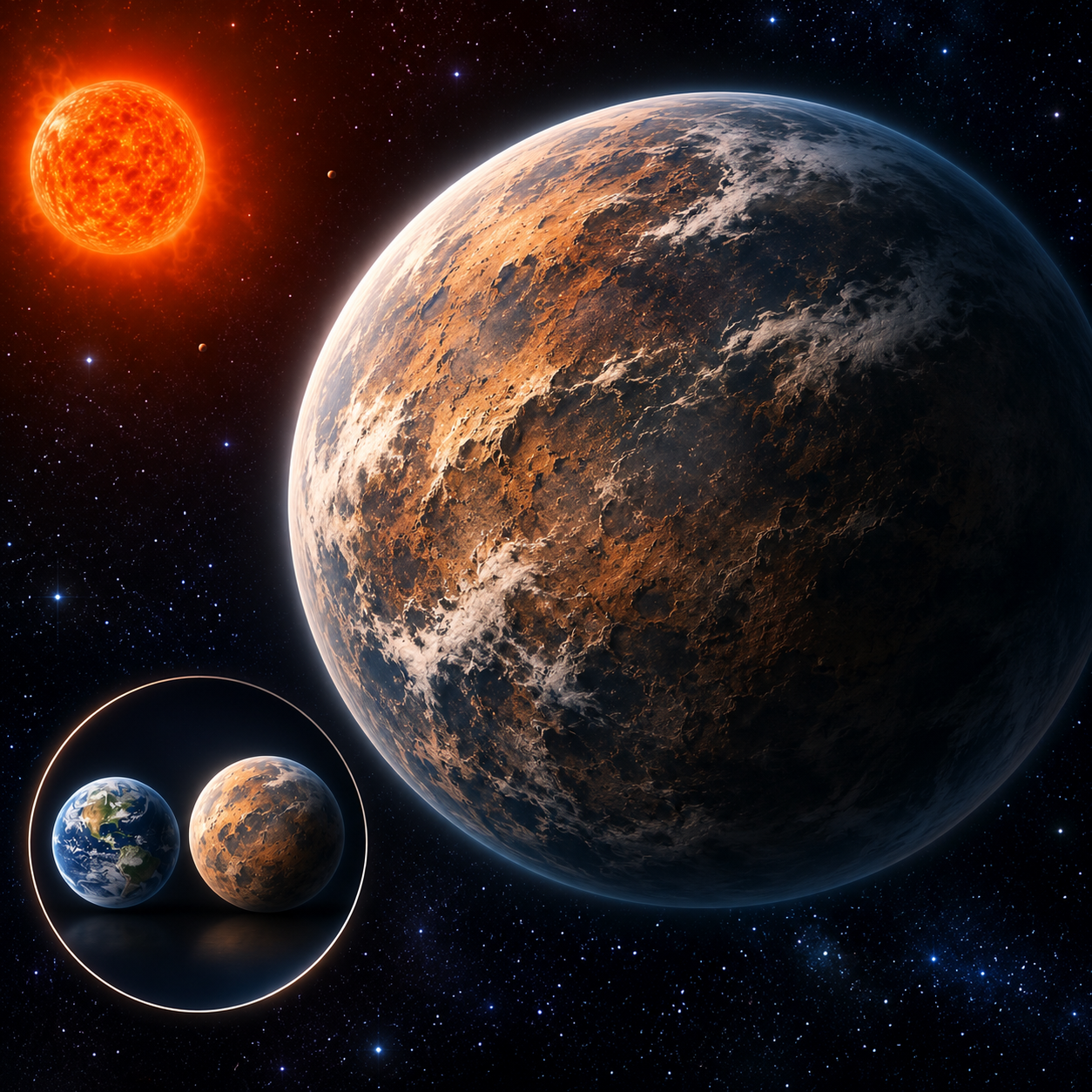
TOI-700 d has a measured radius approximately 1.15 times Earth's, equivalent to roughly 7,300 kilometres.
Its relatively small size suggests that it could possess a predominantly rocky composition, potentially including a silicate mantle and metallic core.
Published planetary mass estimates vary, and its internal composition remains uncertain. Using an illustrative mass of approximately 1.25 Earth masses and a radius of 1.15 Earth radii produces an estimated surface gravity of approximately 0.95 g.
Other plausible mass estimates produce different gravitational values. Therefore, its surface gravity should not yet be treated as a firmly established measurement.
A gravity level reasonably close to Earth's would make TOI-700 d particularly interesting for research into potential human habitation, although its atmospheric and environmental conditions remain unknown.
No mountains, continents, oceans, geological activity or magnetic field have been directly detected.
Orbit and Tidal Locking
TOI-700 d completes one orbit around its star every 37.4 Earth days, at a distance of approximately 24.5 million kilometres (0.164 astronomical units).
Despite orbiting considerably closer to its star than Earth orbits the Sun, it receives less stellar energy because TOI-700 is much smaller and cooler.
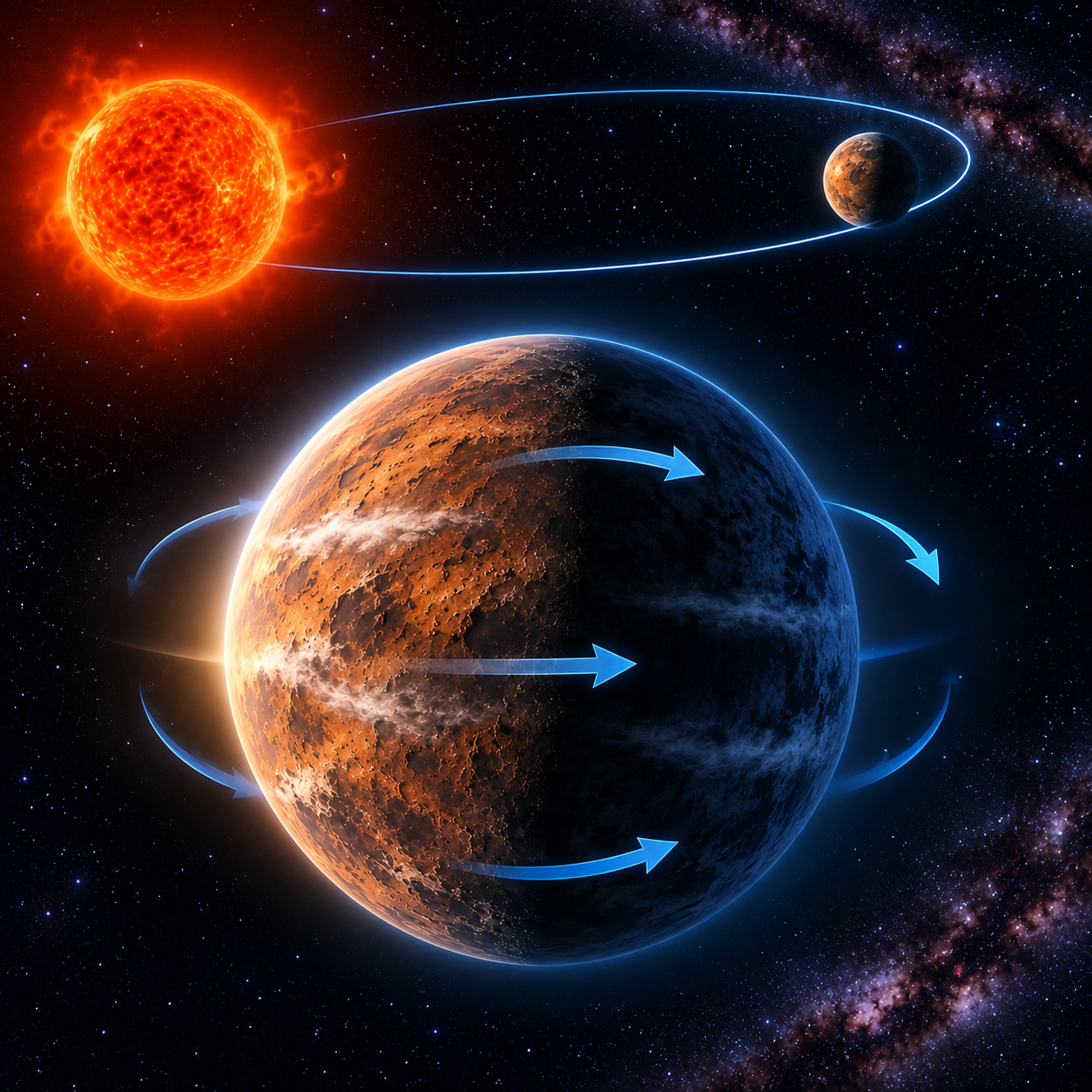
The planet is expected to be tidally locked, although its rotation has not been directly measured.
If tidally locked, one hemisphere would experience permanent daylight while the opposite hemisphere would remain in darkness.
The boundary between these regions, known as the terminator, could experience intermediate temperatures.
A sufficiently substantial atmosphere could redistribute heat through atmospheric circulation, potentially reducing temperature differences between the illuminated and dark hemispheres.

Atmosphere and Climate
Whether TOI-700 d possesses an atmosphere remains one of its most important unanswered questions.
Scientists have modelled several possible atmospheric compositions, including environments containing nitrogen, carbon dioxide and water vapour.
Climate simulations suggest that some combinations of atmospheric pressure, greenhouse gases and surface conditions could maintain temperatures suitable for liquid water.
Other models produce substantially colder environments.
The planet's estimated equilibrium temperature is approximately 269 kelvin, or −4°C. This is a simplified radiative temperature rather than a measured surface temperature and does not account for atmospheric greenhouse warming.
The relatively quiet behaviour observed from TOI-700 may improve the prospects for atmospheric retention, although its earlier stellar activity and the planet's atmospheric history remain uncertain.
Determining whether TOI-700 d possesses a stable atmosphere will be essential for assessing its habitability.
Water, Oceans and Ice

Artist's impression.
TOI-700 d lies within the conservative habitable zone, where suitable atmospheric conditions could permit liquid water to remain stable on the surface.
Scientists have investigated hypothetical environments ranging from ocean-covered planets to worlds with extensive continents, ice sheets and different atmospheric compositions.
For a tidally locked planet, the distribution of water could depend strongly on atmospheric circulation and the transport of heat between hemispheres.
Some climate models suggest that an ocean and atmosphere could distribute sufficient warmth to prevent complete freezing.
Other possibilities include extensive night-side ice deposits or liquid water concentrated in warmer regions.
The planet's actual water inventory remains unknown. No surface oceans, lakes, glaciers or ice deposits have been directly observed.
The Search for Life
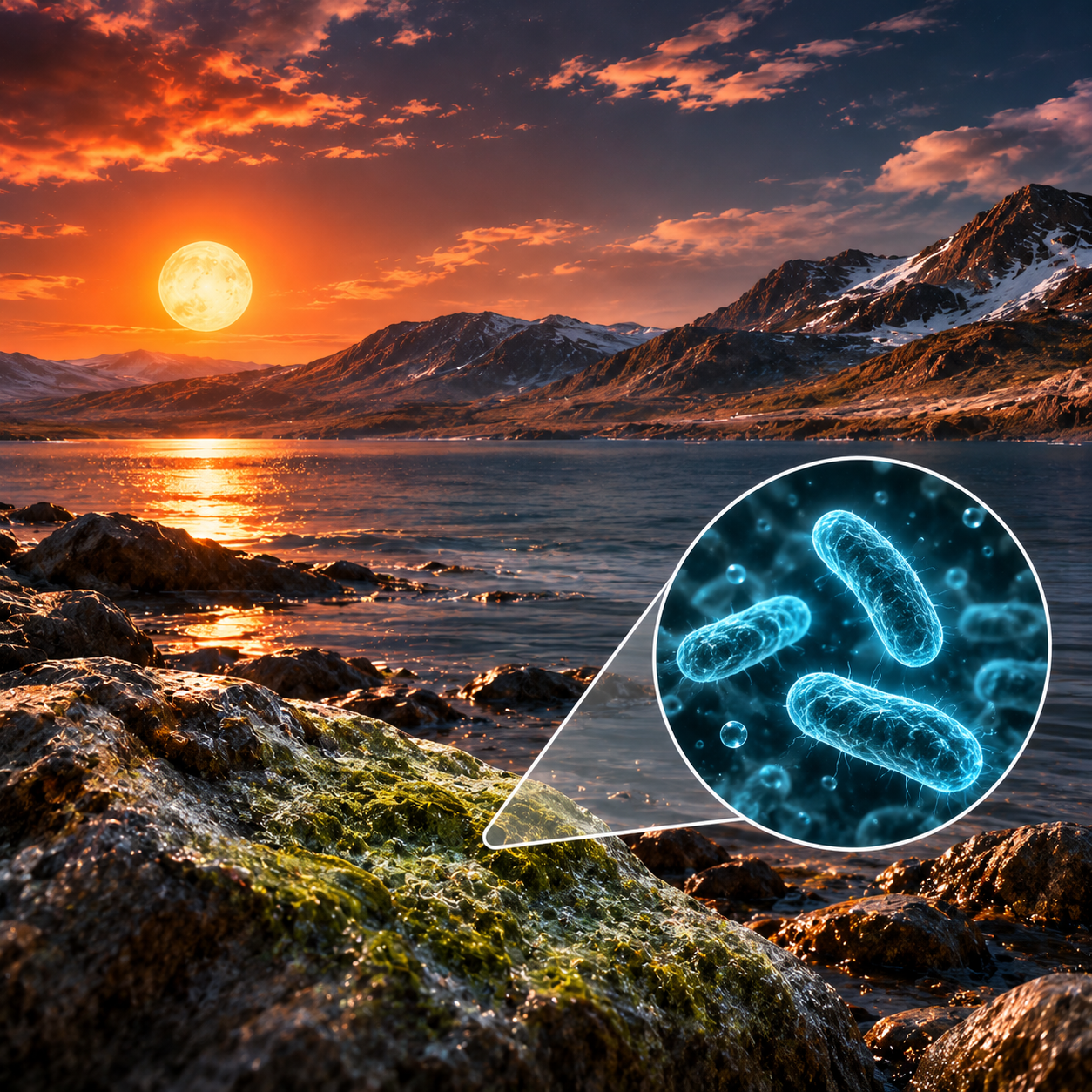
TOI-700 d is an important target in the search for environments beyond Earth that might support biological activity.
Its relatively Earth-like size, potentially rocky composition and habitable-zone position make it scientifically valuable.
A stable atmosphere, suitable temperatures, liquid water and essential chemical ingredients could provide conditions compatible with life as we understand it.
Researchers are particularly interested in whether planets orbiting comparatively quiet red dwarfs can preserve atmospheres over billions of years.
Future atmospheric observations might eventually reveal gases associated with geological or biological processes.
However, detecting potential biosignatures would require careful consideration of non-biological explanations.
No evidence of life has been detected on TOI-700 d.
Space Telescopes and Scientific Observations
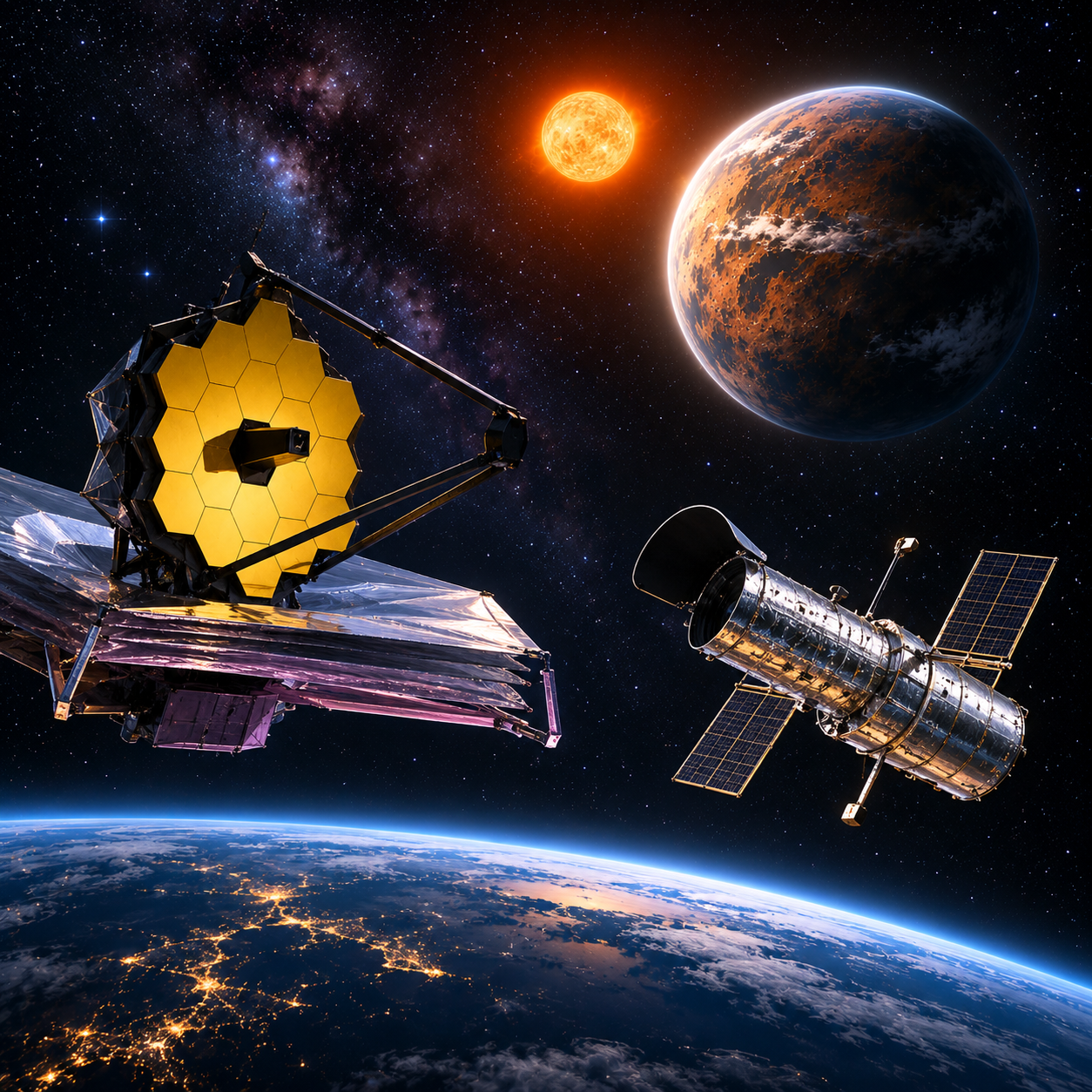
NASA's TESS spacecraft discovered TOI-700 d through repeated measurements of its host star's brightness.
The Spitzer Space Telescope subsequently confirmed the planet's existence through additional infrared observations.
Continued TESS observations have refined the system's orbital characteristics and contributed to the discovery of TOI-700 e.
The James Webb Space Telescope provides powerful capabilities for investigating exoplanet atmospheres, although atmospheric observations of TOI-700 d are especially challenging because of the system's distance and the small atmospheric signals expected.
Researchers are also interested in using highly precise measurements of stellar motion to improve estimates of the planet's mass.
More accurate mass measurements would help determine its density, composition and surface gravity.
European Contributions to Exoplanet Research
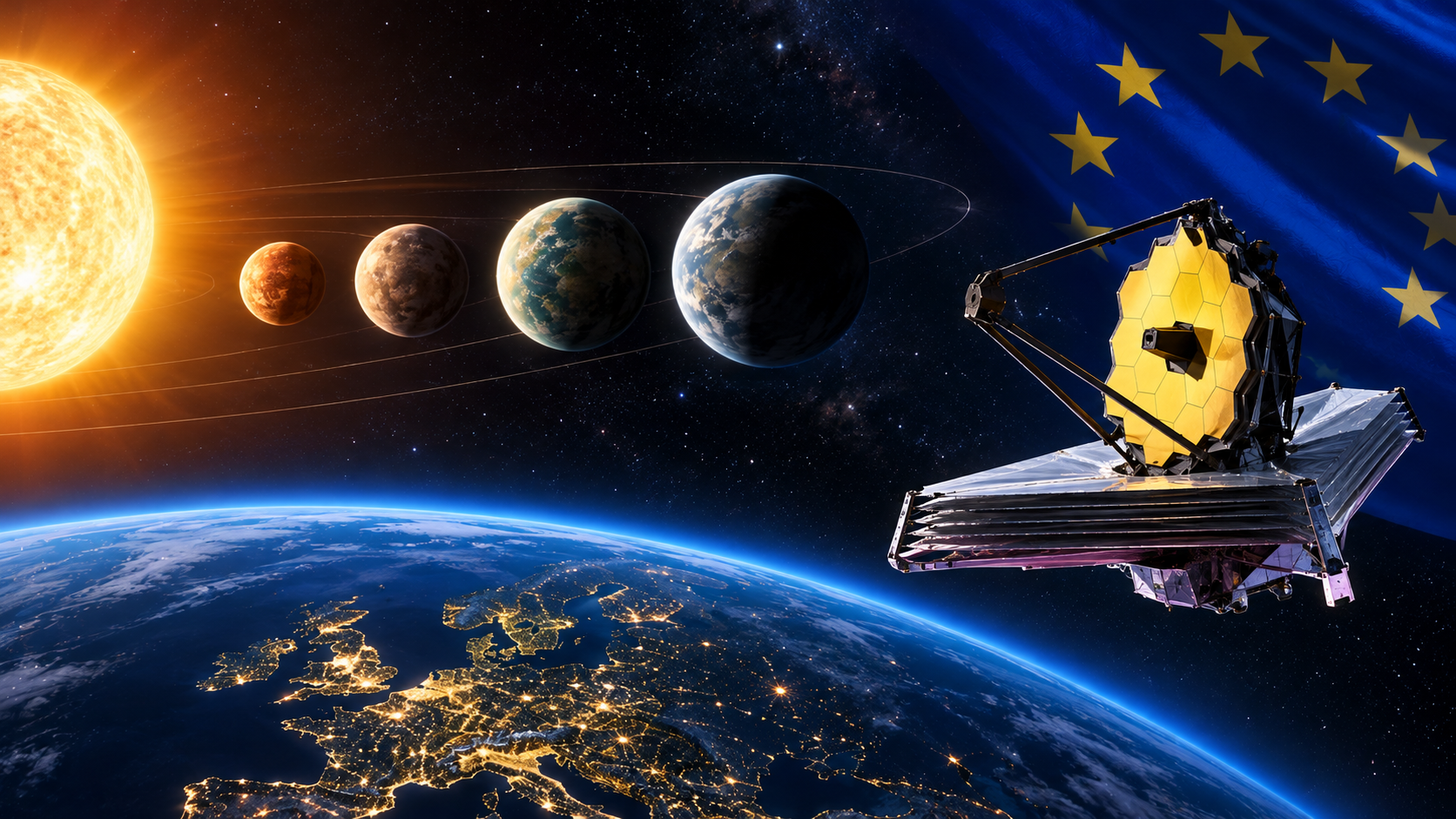
European scientists and institutions contribute substantially to the wider study of rocky exoplanets and planetary habitability.
The European Space Agency's Gaia mission provides precise stellar distances and other measurements that help astronomers determine the properties of planetary systems, including TOI-700.
European observatories and research institutions also contribute to stellar characterisation, planetary modelling and the development of techniques for detecting small exoplanets.
ESA's forthcoming PLATO mission will search for terrestrial planets around bright stars and investigate their physical characteristics.
The Ariel mission will study the atmospheres of a large population of exoplanets, improving our understanding of planetary atmospheric chemistry and evolution.
Although these missions are not specifically intended to investigate TOI-700 d, their scientific findings will help researchers understand the conditions under which potentially habitable planets develop.

Golden dawn over TOI-700 d (artist's impression)
The Future of TOI-700 d Research
Future research will focus on improving TOI-700 d's mass measurements, investigating its likely rocky composition and assessing whether an atmosphere could survive around its host star.
Continued climate modelling will examine how different atmospheric pressures, greenhouse gases and ocean distributions influence temperatures on a potentially tidally locked world.
Comparisons with neighbouring TOI-700 e may be particularly valuable because both planets orbit the same star while receiving different amounts of stellar radiation.
For potential human habitation, TOI-700 d offers an interesting combination of near-Earth size, possibly Earth-like gravity and favourable habitable-zone placement.
However, its atmospheric pressure, composition, radiation environment, water availability and actual surface temperature remain unknown.
Further observations will help establish whether this distant planet possesses conditions suitable for liquid water and potentially life.
Latest Updates
2nd November 2026 — TOI-700 d: A Continuing Target for Habitability Research
TOI-700 d remains an important Earth-sized habitable-zone exoplanet for scientific investigation.
Its measured radius and orbital characteristics are well established, while its mass, surface gravity and atmospheric composition require further investigation.
The discovery of neighbouring TOI-700 e has strengthened the scientific value of the system by providing two small habitable-zone planets for comparative study.
Future research will focus on atmospheric retention, planetary composition and the climate conditions necessary to support liquid water.
Last reviewed: 2nd November 2026