

Space Science & Technology | 23rd November 2026
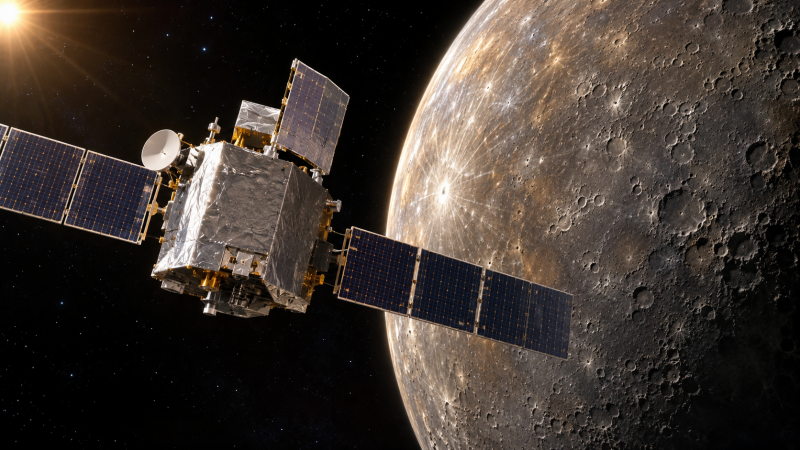
The European Space Agency (ESA) and Japan Aerospace Exploration Agency (JAXA) have successfully placed their BepiColombo spacecraft into orbit around Mercury, despite a software problem that interrupted a critical engine manoeuvre.
The spacecraft entered orbit on 21st November following an eight-year journey through the inner Solar System, becoming only the second mission to orbit Mercury.
However, ESA confirmed on 22nd November that the spacecraft's thrusters fired for less time than planned because of a software issue.
The spacecraft remains safe, and engineers at ESA's European Space Operations Centre (ESOC) in Darmstadt, Germany, are investigating the anomaly.
A Critical Manoeuvre
BepiColombo's orbital insertion required four chemical thrusters aboard ESA's Mercury Planetary Orbiter to fire as the spacecraft approached Mercury at an altitude of approximately 635 kilometres.
The manoeuvre was intended to last around 37 minutes, slowing the spacecraft sufficiently for Mercury's gravity to capture it.
Although the engine burn ended prematurely, flight dynamics specialists confirmed that BepiColombo had successfully entered orbit.
ESA has not yet established publicly whether corrective manoeuvres will be required.
What Happens Next?
BepiColombo carries two scientific spacecraft: ESA's Mercury Planetary Orbiter and JAXA's Mercury Magnetospheric Orbiter, known as Mio.
The orbiters are scheduled to separate on 9th–10th December, followed by further manoeuvres to establish their individual scientific orbits.
The mission is intended to investigate Mercury's surface, interior, magnetic field and surrounding space environment, with routine scientific operations scheduled to begin in April 2027.
ESA has not announced whether the software problem will affect these milestones.
Despite the unexpected interruption, BepiColombo has achieved a significant milestone in European and Japanese planetary exploration. Engineers must now establish the cause of the anomaly and assess its implications for the remaining mission operations.