

Space Science & Technology | 20th November 2026
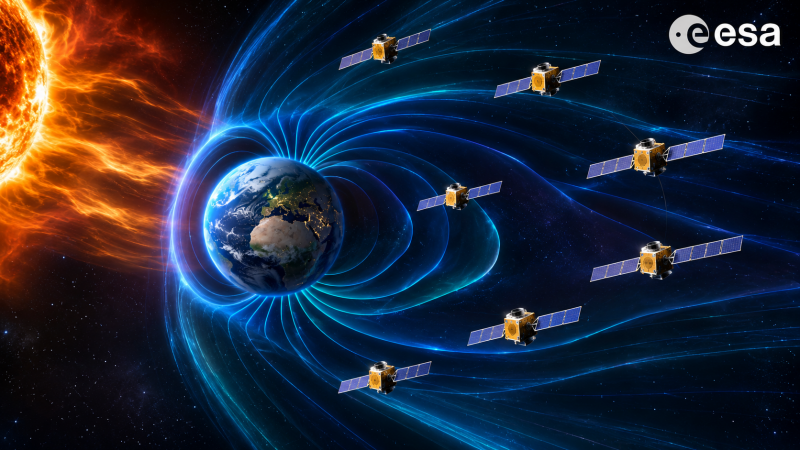
The European Space Agency (ESA) has selected a new seven-spacecraft mission to investigate how energy from the Sun interacts with Earth's protective magnetic field.
Announced on 19th November, Plasma Observatory will examine the movement of electrically charged particles through Earth's magnetosphere, improving scientific understanding of solar activity and its effects on satellites and critical infrastructure.
Unlike previous missions, the seven spacecraft will operate together to measure magnetic fields, electric fields and particles across different distances and timescales simultaneously.
ESA's earlier Cluster mission demonstrated that interactions between the solar wind and Earth's magnetic environment occur across distances ranging from a few kilometres to tens of thousands of kilometres. However, its four spacecraft could not investigate these different scales simultaneously.
Plasma Observatory aims to overcome that limitation, allowing scientists to examine how small, rapidly occurring interactions contribute to larger changes throughout the magnetosphere.
The research could improve understanding of space weather, including the processes behind geomagnetic storms that can disrupt satellite operations, communications and electricity networks.
The mission will also provide information about how magnetic fields interact with charged particles elsewhere in the Solar System, contributing to broader research into planetary environments.
ESA's Member States formally selected Plasma Observatory as the agency's next medium-class science mission following several years of technical and scientific assessments.
The mission must still undergo further development and formal adoption before construction, with launch provisionally expected in the late 2030s.
The selection strengthens Europe's long-term scientific capabilities in studying Earth's magnetic environment and the wider effects of solar activity.