

Space Science & Technology | 19th November 2026
New images from Europe's Mars Express spacecraft have revealed the dramatic remains of an enormous Martian volcano, including a summit that appears to have collapsed twice during its geological history.
The European Space Agency (ESA) and German Aerospace Center (DLR) released the images on 18th November, showing Tharsis Tholus, an eight-kilometre-high volcano in the vast Tharsis volcanic region of Mars.
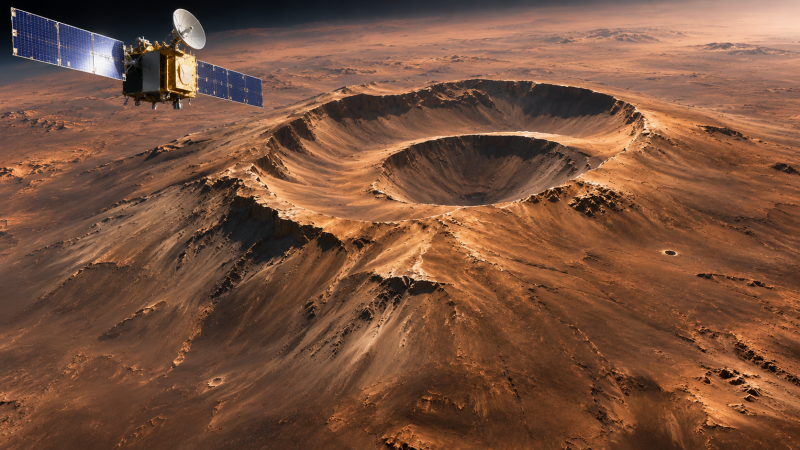
Captured by the German-built High Resolution Stereo Camera (HRSC), the observations reveal two overlapping summit depressions, steep cliffs, fractures and evidence of ancient landslides.
A Volcano That Collapsed Twice
Tharsis Tholus rises approximately eight kilometres above the surrounding lava plains, making it more than twice the height of Mount Etna in Sicily.
Its most striking feature is a large summit depression known as a caldera, formed when underground magma chambers empty during eruptions and the unsupported rock above collapses.
Scientists believe at least two major collapses occurred, creating an older outer caldera and a younger inner depression. The resulting structure is almost three kilometres deep.
The volcano's slopes also contain extensive faults and deep fractures, suggesting its enormous weight caused sections of the surrounding ground to sink and deform.
Reconstructing Mars in Three Dimensions
The images were captured on 15th June 2026 during Mars Express orbit 28,331, at a ground resolution of approximately 18 metres per pixel.
Using measurements from the stereo camera, researchers reconstructed the terrain in three dimensions, allowing the volcano's slopes, summit and surrounding landscape to be examined in greater detail.
The images also reveal smaller impact craters, ancient lava flows and steep escarpments across the volcanic structure.
Mars Express has been orbiting the Red Planet since 2003, with its German-developed camera continuing to provide valuable geological observations more than two decades after launch.
Understanding Mars's Volcanic Past
Mars contains some of the largest volcanoes in the Solar System, including Olympus Mons, which rises nearly 22 kilometres above its surroundings.
Unlike Earth, Mars does not have an active system of moving tectonic plates. Volcanic structures can therefore remain above the same underground magma source for extended periods, allowing them to grow to extraordinary sizes.
Lower gravity and relatively limited erosion also contribute to their preservation.
Scientists believe Tharsis Tholus began forming approximately 3.8 billion years ago, with its last lava eruptions estimated to have occurred around 200 million years ago.
The newly released images provide further evidence of the processes that shaped the Martian surface, helping researchers reconstruct the planet's volcanic history.
Although the observations do not establish whether Tharsis Tholus remains active today, they demonstrate how Europe's long-running Mars Express mission continues to reveal new details about the Red Planet.