

Space Science & Technology | 18th November 2026
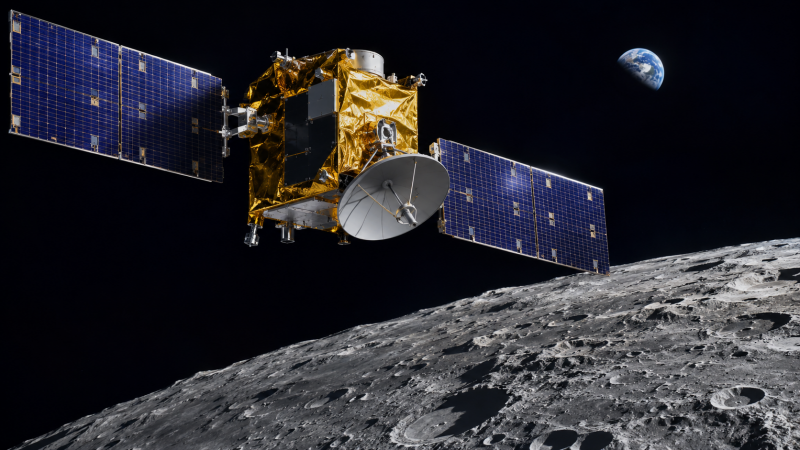
A British-built satellite is undergoing its final preparations ahead of a mission to establish Europe's first dedicated communications service around the Moon, providing an important foundation for future lunar exploration.
Developed by Surrey Satellite Technology Ltd (SSTL) in Guildford, Lunar Pathfinder is designed to relay signals between Earth and spacecraft operating on or around the Moon, including regions where direct communication is difficult or impossible.
The European Space Agency (ESA) confirmed in October that the spacecraft was undergoing its final environmental testing campaign in Britain, with launch now planned for 2027.
Connecting the Far Side of the Moon
Unlike satellites orbiting Earth, lunar spacecraft face particular communication difficulties when travelling behind the Moon, where the lunar surface blocks direct radio signals.
Lunar Pathfinder will address this problem by operating in a specialised elliptical orbit, providing communications coverage across important regions, including parts of the lunar far side and south pole.
The satellite will use radio links to receive information from lunar spacecraft and relay it towards Earth, allowing future missions to communicate without requiring their own dedicated relay satellites.
This could be particularly valuable for smaller robotic landers, scientific instruments and rovers operating in areas beyond direct contact with terrestrial ground stations.
British Engineering and European Technology
The spacecraft is being developed by SSTL through a commercial partnership with ESA, supported by investment from the UK Space Agency.
Its scientific equipment includes a radiation monitor developed in Switzerland, alongside technology designed to investigate whether navigation signals from satellites orbiting Earth can also be detected and used around the Moon.
A separate experiment will test methods of measuring the spacecraft's position using radio signals and laser ranging.
These technologies could eventually help future lunar missions navigate more accurately without relying entirely on tracking from Earth.
Building Europe's Lunar Network
Lunar Pathfinder will become the first element of ESA's wider Moonlight programme, which aims to establish a network of communications and navigation satellites around the Moon.
The planned system will eventually comprise five satellites, including four dedicated to navigation and one to communications, supported by ground stations on Earth.
Much like satellite navigation and telecommunications services already used on Earth, Moonlight is intended to provide shared infrastructure that future lunar missions can use without developing every system independently.
The programme could support Europe's planned Argonaut lunar cargo lander, alongside scientific missions and future human exploration.
Preparing for Launch
Lunar Pathfinder is expected to travel aboard a SpaceX Falcon 9 rocket as part of Firefly Aerospace's second Blue Ghost lunar mission.
Once transported towards the Moon, Firefly's Elytra spacecraft will deploy the British-built satellite into its operational orbit.
The mission is being carried out through an agreement between ESA and NASA, exchanging European communications services for transportation to lunar orbit.
Lunar Pathfinder is expected to operate for approximately eight years, with ten international missions already planning to use its services.
Although the satellite has yet to launch, its development represents a significant British contribution to Europe's plans for independent lunar communications infrastructure.
As exploration moves towards longer missions and more demanding operations on the lunar surface, reliable communications may prove just as important as the spacecraft and landers themselves.