

Space Science & Technology | 17th November 2026
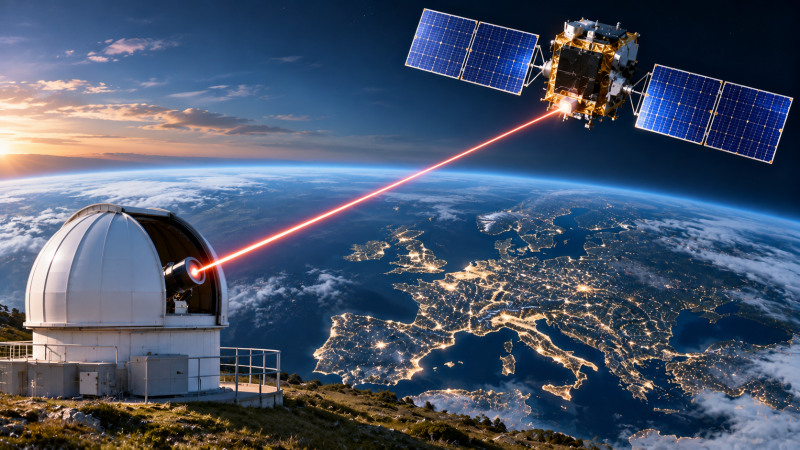
The European Space Agency has expanded its partnership with French-led aerospace company Thales Alenia Space to develop technology that could eventually connect quantum communication networks across continents.
Two amendments to existing contracts, announced on 16th November, will extend work on ESA's TeQuantS project, which began in 2023 with support from the French space agency CNES.
The project aims to overcome one of the main limitations of quantum communications: transmitting delicate quantum information over very long distances.
Unlike conventional internet connections, future quantum networks could allow quantum computers and specialised sensors to exchange information using individual particles of light, known as photons.
However, quantum information is difficult to transmit over long stretches of optical fibre because photons are gradually lost as they travel. Satellites could eventually provide connections between distant ground networks without requiring continuous fibre links.
The first phase of TeQuantS produced a compact ground station prototype and an engineering model of the communications equipment.
The next stage will establish a dedicated laboratory at CNES to test equipment under simulated operating conditions. Researchers will examine systems capable of producing pairs of quantum-entangled photons, synchronising communications between satellites and ground stations, and detecting the signals received on Earth.
The work will also contribute to the proposed QINSAT satellite, intended to demonstrate the transmission of entangled photons between space and Earth.
Quantum entanglement allows particles to share correlations that cannot be explained by ordinary classical physics. These properties could support new forms of secure communication and connections between future quantum computers, although they do not allow information to travel faster than light.
The research has particular importance for European technological independence. Future quantum networks could help governments and other organisations exchange sensitive information through infrastructure developed and controlled within Europe.
Thales Alenia Space, jointly owned by France's Thales and Italy's Leonardo, leads a consortium that includes Airbus Defence and Space, smaller European technology companies and French research institutions.
The expanded programme represents another step towards Europe's ambition to develop its own quantum communications infrastructure. For now, the technology remains in development, with laboratory testing and future satellite demonstrations still needed before such networks become operational.