

Space Science & Technology | 13th November 2026
French-led researchers have identified a possible magnetic-field signature in the atmosphere of an exoplanet 680 light-years from Earth, potentially opening a new way to investigate the magnetic environments of distant worlds.
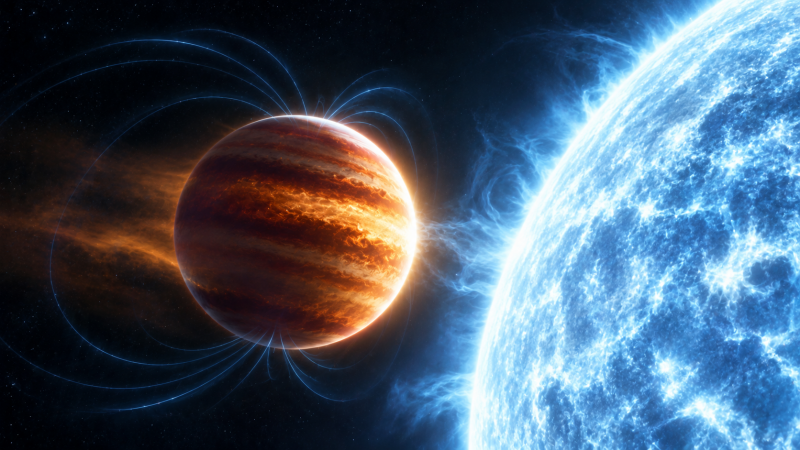
The international team, led by scientists at the University of Toulouse, examined KELT-9b, an extremely hot gas giant nearly three times the mass of Jupiter. Their findings were published in Astronomy & Astrophysics on 27th October.
Using the SPIRou spectropolarimeter at the Canada–France–Hawaii Telescope, researchers observed the planet passing in front of its star on three occasions between September 2025 and July 2026.
The instrument analysed changes in the polarisation of starlight passing through the planet's atmosphere. Magnetic fields can alter the light absorbed by atoms through a phenomenon known as the Zeeman effect, potentially revealing their presence.
During the first observation, researchers detected a faint signal consistent with a magnetic field of approximately 2,000 gauss under a simplified model. However, the signal was absent during two subsequent observations in July 2026.
The team cautioned that the initial detection could represent either a statistical fluctuation or a magnetic field that changes over time. The evidence is therefore insufficient to confirm the discovery.
KELT-9b is particularly suitable for this research because temperatures on its illuminated side approach 4,000°C, producing an electrically conductive atmosphere in which powerful winds could generate magnetic fields.
Planetary magnetic fields are important because they can influence atmospheric escape and interactions with stellar radiation. Understanding these processes could eventually help scientists assess atmospheric stability around other exoplanets, including potentially habitable worlds.
However, KELT-9b itself is far too hot to be considered habitable, and the research does not demonstrate that a magnetic field would guarantee atmospheric protection.
Further observations will be needed to determine whether the original signal was genuine. Even without confirmation, the study demonstrates a promising approach to investigating planetary magnetism beyond the Solar System.
Add comment
Comments