

Space Science & Technology | 12th November 2026
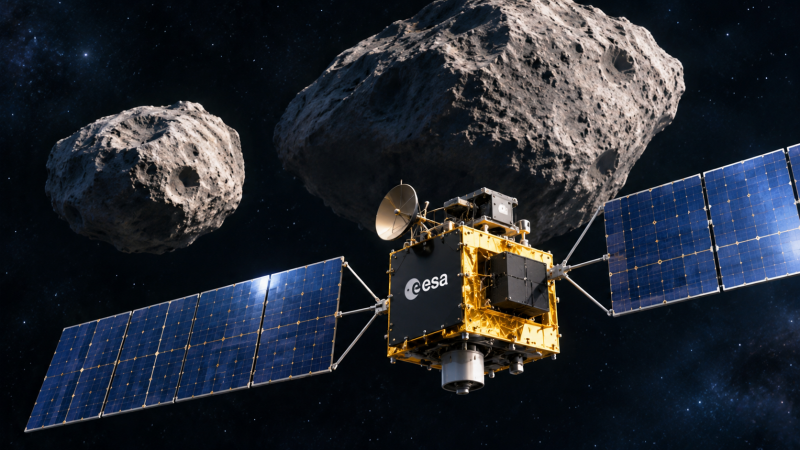
The European Space Agency's Hera spacecraft has begun its first close-range scientific observations of the Didymos asteroid system, marking a major milestone in efforts to understand how potentially dangerous asteroids could be deflected away from Earth.
ESA confirmed on 11th November that Hera is operating approximately 25–30 kilometres from Didymos and its smaller companion, Dimorphos.
The spacecraft is conducting an early characterisation phase, gathering measurements of the two bodies before moving closer for detailed scientific investigations.
Dimorphos was struck by NASA's DART spacecraft in September 2022, deliberately changing its orbit around Didymos by approximately 33 minutes.
Although the impact demonstrated that a spacecraft could alter an asteroid's trajectory, scientists still need to understand how the collision affected Dimorphos's shape, internal structure and surface.
Hera will investigate these questions using imaging instruments and other scientific equipment.
Operating around such small bodies presents unusual navigation challenges because their gravity is extremely weak.
Rather than following a conventional circular orbit, Hera is using a series of controlled rectangular trajectories, with thruster manoeuvres adjusting its course while maintaining a safe distance.
ESA expects the spacecraft to begin more detailed observations during December, before deploying two small companion satellites for closer investigations.
Hera's arrival marks the transition from demonstrating asteroid deflection to investigating the physical evidence needed to make planetary-defence techniques more predictable and reliable.
Add comment
Comments