

Space Science & Technology | 12th November 2026
A German-French robotic rover travelling towards Mars has successfully completed its first full systems test in space, confirming that its scientific instruments and essential equipment are functioning as expected.
The Idefix rover is travelling aboard Japan's Martian Moons eXploration spacecraft, known as MMX, which launched from Tanegashima Space Center on 19th October.
Germany's DLR announced on 10th November that the rover had been activated after travelling more than four million kilometres. Its instruments and relevant onboard systems passed their initial functional checks.
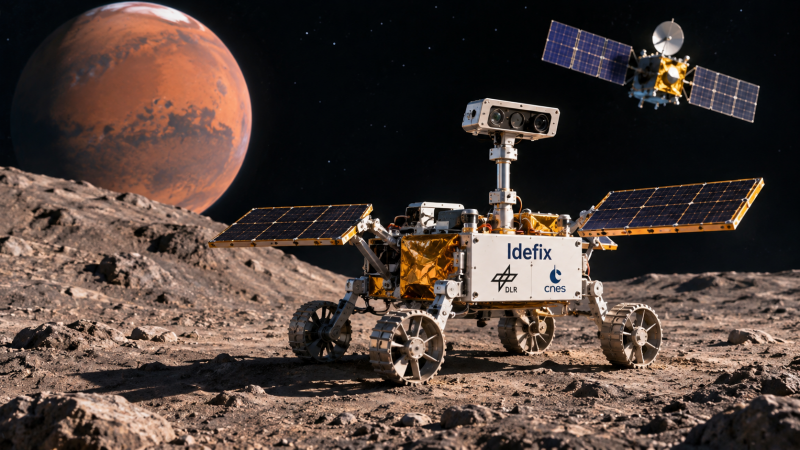
Developed jointly by DLR and the French space agency CNES, Idefix is designed to explore Phobos, the larger of Mars's two moons.
The rover is expected to reach the surface around late 2028 or early 2029, becoming the first mobile robotic vehicle to operate on a Martian moon if the landing succeeds.
Phobos presents unusual engineering challenges. Its gravity is less than one-thousandth of Earth's, meaning the rover will be released from the spacecraft without a conventional powered landing system.
After touching down and potentially bouncing across the surface, Idefix must right itself autonomously before deploying its solar panels and beginning scientific operations.
Its instruments will investigate surface composition, temperature and mechanical properties, helping scientists understand the moon's origins and identify suitable locations for sample collection.
Japan's MMX mission aims to return samples from Phobos to Earth in 2031.
The successful systems test represents an early milestone for European robotics technology and an international mission that could reveal how Mars's moons formed.
Add comment
Comments