

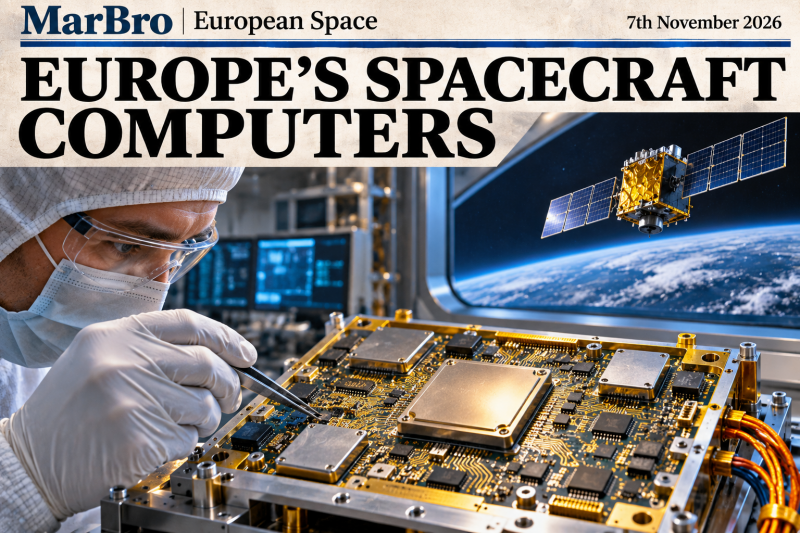
Europe Develops the Next Generation of Spacecraft Computers
Space Science & Technology | 7th November 2026
European engineers are developing more powerful, radiation-resistant spacecraft computers, strengthening Europe's ability to operate satellites and deep-space missions independently.
At the European Space Agency's ESTEC research centre in the Netherlands, specialists gathered on 5–6 November to present advances in spacecraft electronics, onboard artificial intelligence and high-speed communications.
The presentations included radiation testing of advanced processors, autonomous computing systems, satellite data compression and technologies designed to improve the reliability of spacecraft operating far from Earth.
Computers Built to Survive Space
Unlike conventional computers, spacecraft processors must withstand radiation, extreme temperatures and prolonged periods without maintenance.
European researchers are investigating methods to protect advanced electronics against radiation-induced errors while increasing their processing capabilities.
Projects presented at ESTEC included testing sophisticated programmable chips against protons and heavy ions, alongside software verification methods designed to identify faults before spacecraft launch.
Engineers also presented onboard AI processing systems and technologies capable of compressing scientific images and video before transmission to Earth.
These advances could allow future spacecraft to analyse observations, manage complex operations and transmit scientific data more efficiently without relying entirely on ground-based computers.
Strengthening European Independence
Europe has already developed its own family of space processors, including the LEON architecture used aboard ESA spacecraft.
The agency is continuing to investigate more capable computing systems, while European Union programmes support the development of critical semiconductor technologies.
Reducing reliance on externally supplied components could improve supply-chain security and give European manufacturers greater control over spacecraft design.
The importance extends beyond satellites. Future missions exploring the Moon, Mars and distant planetary systems will increasingly depend on computers capable of making routine decisions without immediate instructions from Earth.
By developing its own processors, software and communications technologies, Europe is strengthening the technological foundations needed for more capable and independent space exploration.