

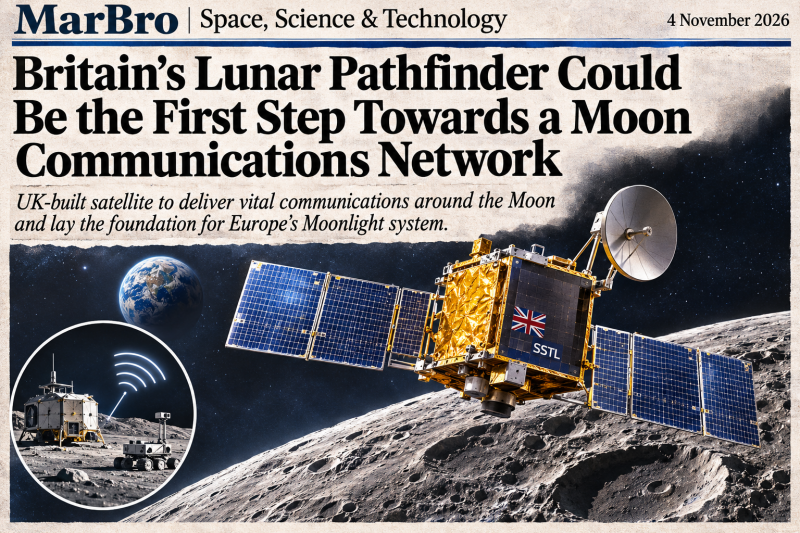
Britain's Lunar Pathfinder: Building Europe's Moon Communications Network
A British-built satellite scheduled for launch in 2027 could transform lunar exploration by providing communications services to spacecraft, landers and rovers operating around the Moon.
Developed by Surrey Satellite Technology Ltd (SSTL) in Guildford, Lunar Pathfinder represents a significant step towards establishing Europe's own lunar communications infrastructure.
The spacecraft, developed in partnership with the European Space Agency (ESA), will become the first element of Moonlight, an ambitious European project to establish communications and navigation services around the Moon.
Connecting the Far Side of the Moon
Unlike Earth, the Moon has no established satellite communications network. Spacecraft operating beyond Earth's direct line of sight face significant challenges transmitting scientific data and receiving instructions.
Lunar Pathfinder will address this problem by acting as a communications relay between Earth and spacecraft operating on or around the Moon.
Using S-band and UHF radio links to communicate with lunar equipment, alongside an X-band connection to Earth, the satellite will help missions operate in areas where direct communications would otherwise be difficult.
Its planned elliptical lunar orbit will provide extended coverage of the Moon's southern hemisphere, including important polar and far-side regions.
Britain's Contribution to European Space Independence
Lunar Pathfinder demonstrates the growing importance of British engineering within Europe's space infrastructure.
The satellite has been developed by SSTL, with contributions from British companies including QinetiQ and Cornwall's Goonhilly Earth Station.
It will also carry scientific and navigation experiments, including equipment designed to investigate whether navigation signals transmitted by satellites around Earth can be detected and used near the Moon.
These technologies could contribute to future lunar positioning systems, allowing spacecraft and eventually astronauts to navigate more independently.
The Beginning of Europe's Moonlight Network
Lunar Pathfinder is intended to demonstrate services that will eventually expand into ESA's Moonlight programme.
Moonlight is designed to establish a constellation of five satellites providing communications and navigation services around the Moon.
Four satellites are planned for navigation, with another dedicated to communications. The network will particularly support exploration of the lunar south pole, where permanently shadowed craters may contain valuable water ice.
Such infrastructure could reduce the complexity and cost of future missions, allowing landers, rovers and scientific equipment to access shared communications services rather than carrying dedicated relay systems.
Preparing for a Permanent Human Presence
Lunar Pathfinder is expected to launch aboard a SpaceX Falcon 9 rocket as part of Firefly Aerospace's Blue Ghost Mission 2.
Once deployed into lunar orbit, it is designed to provide communications services for approximately eight years.
The spacecraft is also expected to support NASA's LuSEE-Night experiment, which will investigate radio signals from the far side of the Moon.
With future missions planning to explore the lunar surface, construct scientific installations and potentially establish long-duration human habitats, reliable communications will become increasingly important.
For Britain and Europe, Lunar Pathfinder represents more than a single satellite. It is an early step towards the infrastructure needed to support sustained lunar exploration and a more independent European presence beyond Earth.