

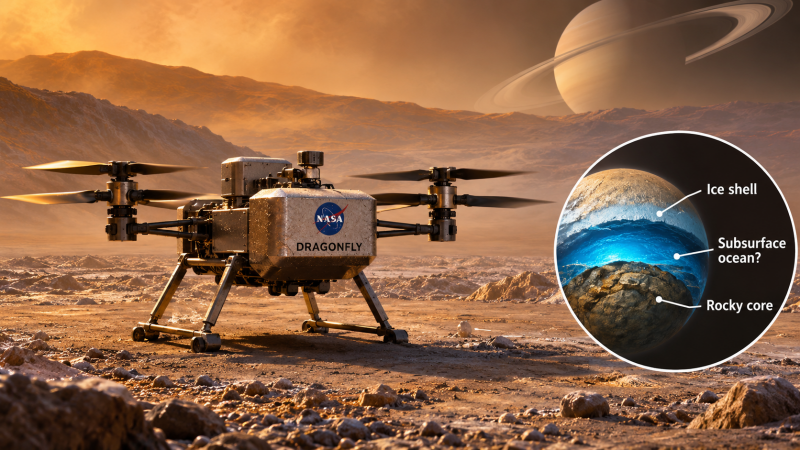
Could Dragonfly Finally Settle the Mystery of Titan's Hidden Ocean?
New research suggests NASA's Dragonfly mission could determine whether Saturn's largest moon contains a vast underground ocean, using radio signals already planned for spacecraft communications.
Titan has long fascinated planetary scientists because of its dense atmosphere, methane lakes, complex organic chemistry and the possibility of a hidden ocean of liquid water beneath its frozen surface.
However, recent interpretations of measurements collected by NASA's Cassini spacecraft have challenged the assumption that such an ocean exists.
A study published on 20 October 2026 in Geophysical Research Letters proposes a new way to investigate the mystery when NASA's Dragonfly rotorcraft reaches Titan in 2034.
Using Radio Signals to Investigate Titan
Researchers Flavio Petricca and Dustin Buccino, from NASA's Jet Propulsion Laboratory, propose using Dragonfly's existing radio communications system to measure tiny variations in Titan's rotation and surface deformation.
As Titan orbits Saturn, the giant planet's gravitational forces periodically stretch and compress the moon. The way Titan responds depends partly on its internal structure.
An underground ocean could allow the outer icy shell to move differently from the deeper interior. A largely solid interior would produce a different rotational and tidal response.
By precisely measuring the radio signals exchanged between Dragonfly and Earth, scientists could distinguish between these possibilities.
Importantly, the proposed experiment would require no additional spacecraft hardware.
Why Titan's Ocean Is Being Questioned
Earlier Cassini observations supported the possibility of a global underground ocean.
More recent analyses, however, suggest that Titan's observed tidal behaviour might also be explained by warm, deformable layers of high-pressure ice surrounding its rocky interior.
This alternative interpretation has reopened an important scientific question: does Titan contain a global liquid-water ocean, or can its unusual behaviour be explained without one?
The new study's simulations suggest that Dragonfly could measure Titan's rotational oscillations and tidal deformation with sufficient precision to distinguish between the competing models.
What This Means for Habitability
Titan's surface is exceptionally cold, with lakes and seas composed primarily of liquid methane and ethane rather than water.
A subsurface water ocean would provide a very different environment, potentially containing liquid water, dissolved chemicals and sources of energy relevant to microbial habitability.
Confirming whether such an ocean exists would therefore significantly improve our understanding of Titan's potential to support life.
Dragonfly is currently scheduled to launch in 2028 and arrive in late 2034. Its primary mission will investigate Titan's chemistry, geology and potential habitability while travelling between different surface locations.
If the proposed radio experiment is implemented successfully, the spacecraft could also provide the most precise measurements yet of Titan's deep interior.
For a world already remarkable for its atmosphere, weather and methane cycle, Dragonfly may finally reveal whether an entirely different environment lies beneath the ice.