

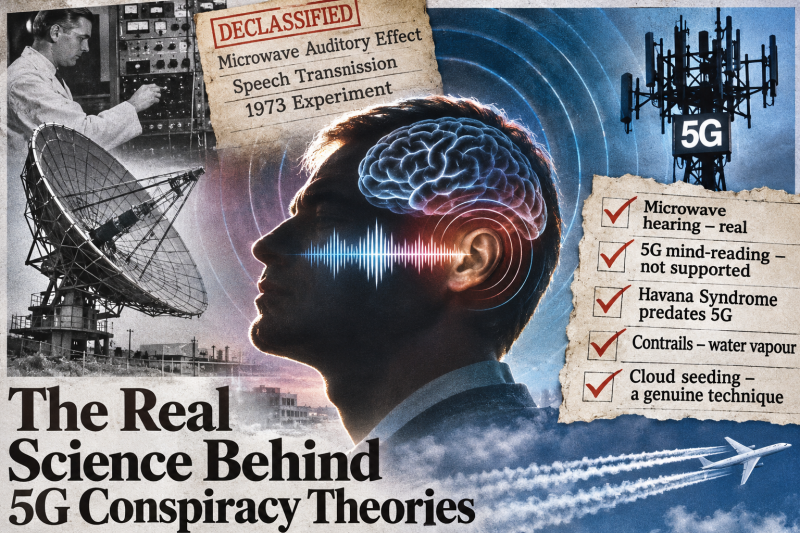
The Real Science Behind 5G Conspiracy Theories: Microwave Hearing
From Cold War laboratories to Havana Syndrome, eight decades of research reveal a genuine scientific phenomenon often misrepresented by modern conspiracy theories.
Claims that 5G networks can read thoughts, transmit voices into people's heads or secretly control the population have circulated widely online. Yet behind some of these claims lies a genuine, documented scientific history that began long before mobile telecommunications existed.
The distinction is important. The microwave auditory effect (MAE) is real. Claims that ordinary 5G networks can read minds are not supported by scientific evidence.
The Cold War Research Behind Microwave Hearing
Beginning in the 1940s, researchers investigated reports of auditory sensations associated with radar equipment. During the 1960s, American scientist Allan H. Frey demonstrated that pulsed microwave radiation could produce perceived clicks, buzzing and other sounds without conventional loudspeakers.
The mechanism is generally explained through the thermoelastic effect. Brief microwave pulses deposit small amounts of energy in tissue, producing rapid thermal expansion and acoustic pressure waves that stimulate the auditory system.
In 1975, psychologist Don R. Justesen published Microwaves and Behavior, describing experiments conducted in 1973 in which Joseph C. Sharp reportedly recognised recorded spoken words encoded into microwave pulses. Other research examined the transmission of recognisable patterns, including Morse code.
These were experiments involving specialised microwave equipment, not demonstrations of thought-reading.
The historical record spans American military and civilian laboratories, alongside a smaller body of Soviet research, including experiments at Pushchino during the late 1970s.
Why 5G Is Not a Mind-Reading Network
Modern 5G networks transmit digital communications between devices and telecommunications infrastructure. They do not decode thoughts or automatically identify a person's internal speech.
Radar and passive radio-frequency sensing are different technologies. Passive radar can exploit existing transmissions, potentially including mobile signals, to detect movement through changes in reflected radio waves. However, this requires suitable receivers, processing equipment and environmental conditions. It is not the same as a mobile network routinely tracking an individual's movements inside a building.
Even where radio-frequency sensing is possible, detecting movement does not mean reading thoughts.
Likewise, reproducing the microwave auditory effect requires suitable pulsed electromagnetic exposure from specific radar parameters. The historical speech experiments relied on specially modulated microwave pulses, not ordinary mobile telephone communications.
Havana Syndrome Predates Commercial 5G
The chronology raises another important distinction.
Justesen's account of microwave-transmitted speech dates to 1973. The first reported Havana Syndrome incidents in Cuba emerged in late 2016, while commercial 5G networks began launching internationally in 2019.
Reports from Havana included perceived sounds, head pressure, dizziness and other neurological or vestibular symptoms.
Some descriptions overlap with sensations examined in historical microwave research, although the reported symptoms has not been verified as a consequence of the microwave auditory effect.
Whatever ultimately explains those incidents, 5G cannot account for the original reports as a newly introduced commercial technology.
Where Conspiracy Theories Meet Genuine Science
The confusion resembles claims surrounding so-called 'chemtrails'. Aircraft condensation trails are primarily ice crystals formed from water vapour, not evidence of secret cancer-causing chemical spraying.
However, cloud seeding is a genuine scientific practice that introduces substances such as silver iodide into existing clouds to encourage rainfall or snowfall, sometimes to alleviate drought. Its effectiveness depends on atmospheric conditions.
Conspiracy theories can blur these distinctions, presenting genuine weather modification as evidence of secret government agendas.
Microwave hearing faces similar misinformation. Genuine Cold War experiments involving encoded speech have become entangled with unsupported claims about 5G mind-reading and figures such as Bill Gates.
There is no credible evidence that Bill Gates or Microsoft were involved in the microwave speech transmission research conducted by Joseph C. Sharp and Mark Grove, which combined encoded speech syllables with microwave pulses. Microsoft was founded two years after those experiments, in 1975.
The documented history is more interesting. Researchers working in American laboratories, including the former Walter Reed Army Institute of Research in Washington, DC — distinct from today's Walter Reed National Military Medical Center in Bethesda — established microwave-induced auditory perception decades before modern smartphones.
The Historical Evidence Matters
Eight decades of microwave auditory research demonstrate why genuine scientific findings should not be confused with modern technological rumours.
Frey's experiments, Justesen's paper about encoded speech, subsequent American experiments and limited Soviet research provide a documented foundation for understanding microwave hearing.
The scientific distinction is straightforward: microwave-induced sound perception is a demonstrated physical phenomenon; 5G mind-reading remains an unsupported claim.
Understanding that difference preserves an important chapter of research history while preventing misinformation from obscuring what scientists actually discovered.