

Technology & Cybersecurity | 28th November 2026
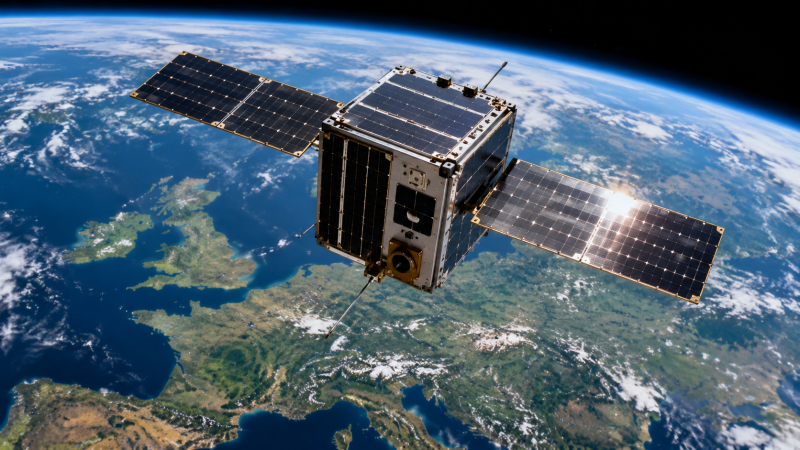
The European Space Agency (ESA) has assumed operational control of CyberCUBE, a small experimental satellite designed to investigate cybersecurity threats and develop technologies to protect European space infrastructure.
The handover was announced on 19th November by European technology company GMV, following the successful completion of commissioning tests at ESA's European Space Security and Education Centre in Belgium.
Launched on 7th July 2026, CyberCUBE was developed through cooperation between GMV's Romanian and Spanish teams and Spanish satellite manufacturer Alén Space.
The spacecraft serves as an experimental laboratory in orbit, allowing researchers to evaluate cybersecurity technologies under real operating conditions.
Planned experiments include detecting unauthorised access to satellite command systems, identifying radio frequency interference, countering signal jamming and spoofing, and evaluating post-quantum cryptography designed to withstand attacks from future quantum computers.
ESA's ground infrastructure in Germany will support the mission through S-band and X-band communications, alongside radio frequency monitoring to help identify interference.
As modern societies become increasingly dependent on satellites for communications, navigation, transport, defence and environmental monitoring, protecting space infrastructure against cyberattacks is becoming a strategic priority.
CyberCUBE will allow Europe to develop and evaluate its own cybersecurity solutions before incorporating them into future spacecraft, strengthening European technological independence and the resilience of critical infrastructure both on Earth and in space.