

Science & Human Cognition | 24th November 2026
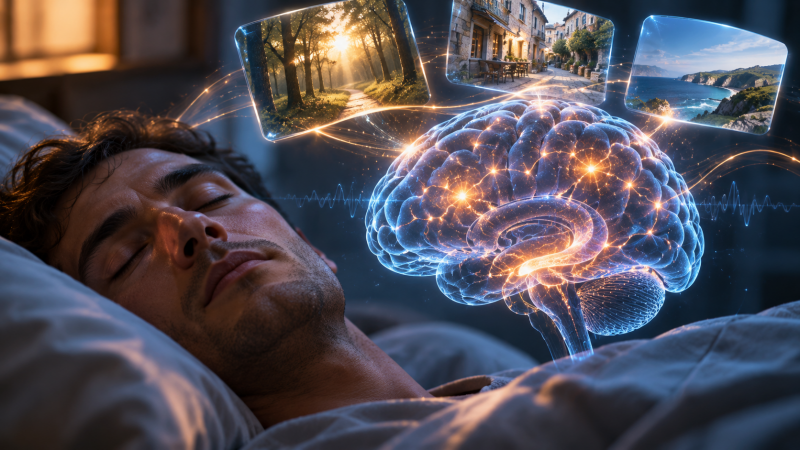
European scientists have discovered that the human brain reactivates individual elements of remembered experiences during sleep without necessarily reproducing the order in which they originally occurred.
The research, published in Nature Communications on 22nd November, involved scientists from Germany, Austria and Switzerland and provides new insight into how the brain processes and consolidates memories during sleep.
Researchers recorded activity from 1,415 neurons in neurosurgical patients who were asked to learn a story containing specific concepts.
The study focused on concept neurons, specialised brain cells that respond to particular people, objects or ideas.
After the learning exercise, researchers monitored neuronal activity during slow-wave sleep, a stage of deep sleep associated with memory consolidation.
Neurons representing concepts encountered in the story became active again, often within close temporal proximity to one another. However, their activation did not follow the original sequence of events.
Previous animal studies have shown that neurons associated with physical locations can reactivate in sequences resembling an animal's earlier movements through an environment.
The new human research suggests that conceptual memories may be processed differently, with the brain reactivating individual components of an experience rather than replaying them in chronological order.
Much of this activity occurred during brief bursts of coordinated neuronal activity known as sharp-wave ripples, which play an important role in memory consolidation.
The findings offer further insight into the reconstructive nature of human memory, in which experiences are formed from interconnected information about people, places, objects and events.
By recording individual neurons in the human brain, the researchers have been able to examine how these connections are reactivated during sleep.
Although the study did not examine conscious dreaming directly, its findings provide a new perspective on how the sleeping brain organises remembered information and strengthens associations between different elements of an experience.