

Space Science & Technology | 20th November 2026
The European Space Agency (ESA) has shortlisted a proposed mission to investigate the dwarf planet Ceres, examining whether its subsurface environment could once have supported conditions suitable for life.
The mission, known as CALICO+, is one of four candidates selected for further study under ESA's next medium-class science mission programme.
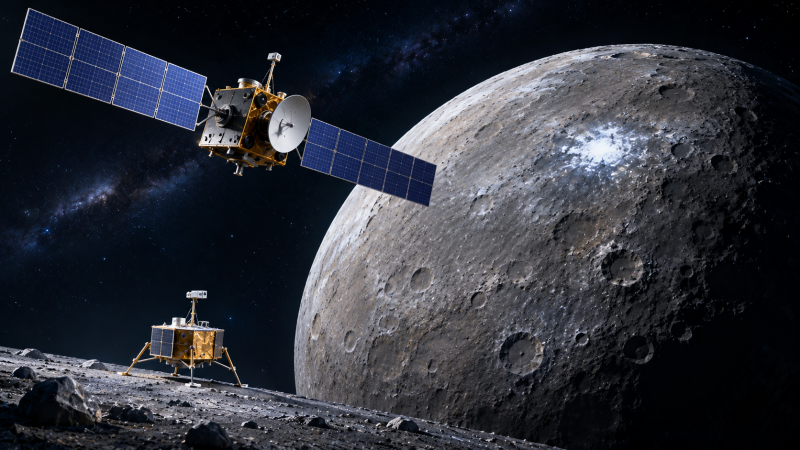
The concept combines an orbiting spacecraft with a small lander, allowing scientists to investigate Ceres from orbit and examine its surface directly.
Located in the asteroid belt between Mars and Jupiter, Ceres is the largest object in that region and is believed to contain substantial quantities of water ice.
NASA's Dawn spacecraft previously revealed evidence of salts, organic compounds and geological activity, suggesting that liquid water may have existed beneath its surface.
These discoveries have made Ceres an important target for research into environments that could potentially support life beyond Earth.
Investigating an Ancient Ocean World
CALICO+ would focus on understanding the history of Ceres's water-rich interior and the chemical processes that shaped its surface.
Particular attention would be given to organic materials, ammonium-bearing compounds and salt deposits, which may preserve evidence of interactions between water, minerals and other chemicals.
Such investigations could help determine whether Ceres once possessed the combination of liquid water, chemical ingredients and energy sources associated with potentially habitable environments.
However, the presence of these ingredients would not establish that life ever existed there.
The proposed mission would also contribute to understanding how water and organic materials were distributed during the formation of the Solar System.
Selection Expected in 2030
ESA announced the shortlist on 19th November as part of its latest science mission selection.
CALICO+ will compete against three other proposals investigating fundamental physics, asteroid samples and solar activity.
Initial studies will begin in 2027, examining scientific requirements, costs and technical challenges.
ESA expects to select the successful medium-class mission in 2030.
CALICO+ therefore remains a proposal rather than an approved spacecraft mission. Nevertheless, its inclusion on the shortlist reflects growing scientific interest in Ceres as a possible ancient ocean world and a target for future European exploration.