

Space Science & Technology | 11th November 2026
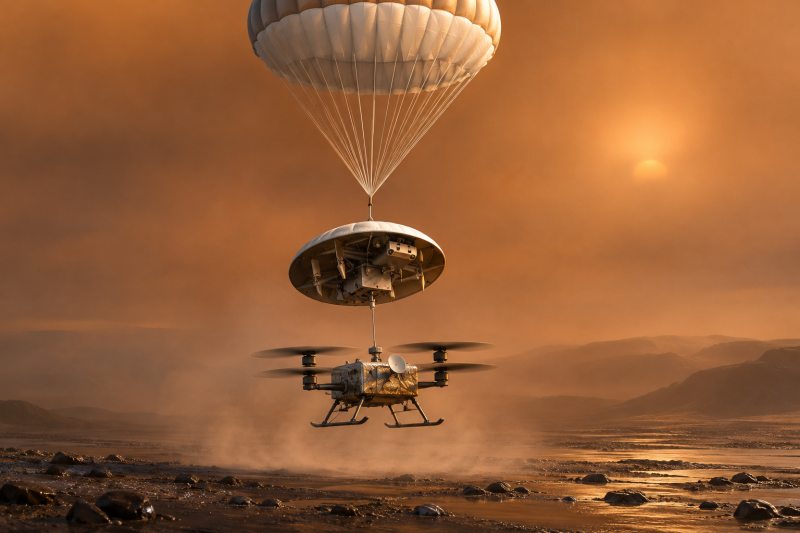
German aerospace engineers are developing instruments that will measure the extreme conditions encountered when NASA's Dragonfly spacecraft enters the atmosphere of Saturn's largest moon, Titan.
The German Aerospace Center (DLR) is contributing specialised sensors and a data-acquisition system to Dragonfly's entry capsule through its TITENT project.
Dragonfly is designed to explore Titan's surface using a nuclear-powered rotorcraft, investigating organic chemistry and environmental conditions that could provide clues about the processes preceding life.
Before beginning that mission, the spacecraft must survive a high-speed descent through Titan's dense nitrogen-rich atmosphere.
Although Titan's atmosphere is considerably thicker than Earth's, atmospheric entry still produces intense heating as the spacecraft rapidly decelerates.
DLR's instrumentation will measure conditions affecting the capsule's heat shield, including temperature, pressure and thermal radiation.
The measurements form part of Dragonfly's Engineering Science Investigation, known as DrEAM, which is led by NASA's Ames Research Center.
The German contribution builds upon instruments developed for the European Space Agency's ExoMars Schiaparelli entry demonstrator in 2016.
Scientists expect the data to improve their understanding of atmospheric-entry heating and help validate computer models used to design future planetary spacecraft.
After its descent, Dragonfly will travel between locations on Titan, analysing surface materials and investigating the moon's complex organic chemistry.
The German instruments will not directly search for life, but their measurements could improve the safety and reliability of future missions exploring Titan and other distant worlds.
Add comment
Comments