

General News & Current Affairs | 10th November 2026
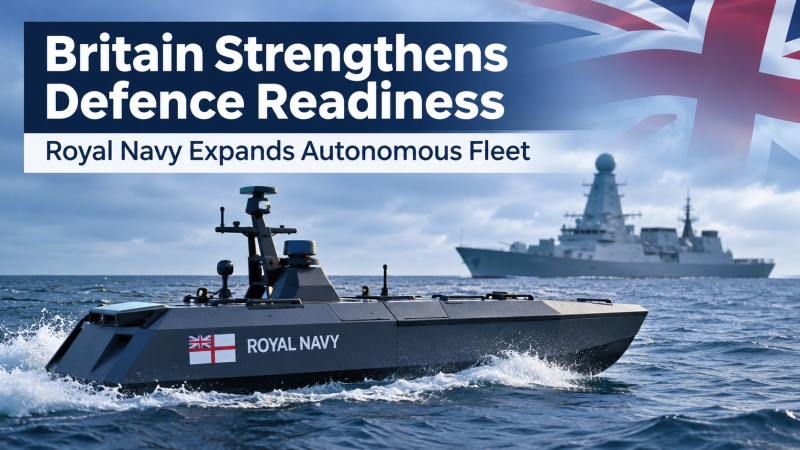
Britain is expanding its military capabilities and preparing for emerging security threats, with the Royal Navy establishing its first autonomous squadron and the government planning a major national defence exercise for 2027.
The developments come amid renewed warnings about Russian activity, growing European military cooperation and continuing debate over Britain's relationship with the European Union.
Royal Navy Establishes First Autonomous Squadron
The Royal Navy announced on 9th November that its first dedicated autonomous squadron had been formally commissioned at Portsmouth four days earlier.
The approximately 180-strong unit will operate uncrewed surface vessels, including Kraken and Rattler systems, as part of the Navy's transition towards a hybrid fleet combining crewed warships with autonomous technology.
The squadron succeeds Project Beehive and forms part of wider investment in maritime autonomy. Its capabilities are expected to develop progressively as new systems enter service.
Government Prepares Major Defence Exercise
The Ministry of Defence is also preparing Exercise Albiston Shadow 2027, intended to test Britain's ability to respond to national emergencies and hybrid threats.
The exercise will involve government departments and examine emergency coordination, including arrangements contained within the Government War Book.
Hybrid threats can involve cyberattacks, infrastructure sabotage, disinformation and conventional military pressure. The exercise is expected to assess national preparedness, although its detailed scenarios have not yet been published.
European Defence Cooperation Expands
Britain and France began Exercise Koalicja in Poland on 9th November, involving approximately 2,800 personnel from 11 countries.
The exercise is designed to prepare the proposed Multinational Force Ukraine for possible security operations following an end to hostilities. It does not constitute a deployment into Ukraine.
Meanwhile, Chief of the Defence Staff Sir Richard Knighton has warned that Britain and its European allies must strengthen their readiness against Russian threats.
The UK-led Joint Expeditionary Force continues developing cooperation among northern European countries, particularly around Baltic Sea security, Arctic operations and protection of undersea infrastructure. No new JEF agreement has been confirmed during the latest reporting period.
Cybersecurity and Critical Infrastructure
European authorities continue investigating cyberattacks affecting refrigeration systems used by supermarkets and other organisations.
The incidents have highlighted vulnerabilities in remotely accessible industrial equipment and the potential consequences for food distribution and essential services.
Although pro-Russian groups have reportedly claimed responsibility, publicly available evidence has not established Russian state direction.
UK–EU Relations Remain Under Discussion
Closer cooperation with Europe remains a significant political issue ahead of the planned UK–EU summit on 20th November.
Negotiations include agricultural trade, youth mobility, scientific cooperation and electricity-market integration.
Several European governments have called for stronger UK participation in Europe's electricity market, particularly to support North Sea energy development.
However, no comprehensive new agreement has yet been concluded.
Outlook
Britain's expanding autonomous naval capabilities, national defence preparations and closer European military cooperation reflect an increasing emphasis on security and resilience.
Further developments are expected from ongoing multinational exercises, UK–EU negotiations and investigations into cyber threats affecting European infrastructure.
Add comment
Comments