

RF Systems & Havana Syndrome | 9th November 2026
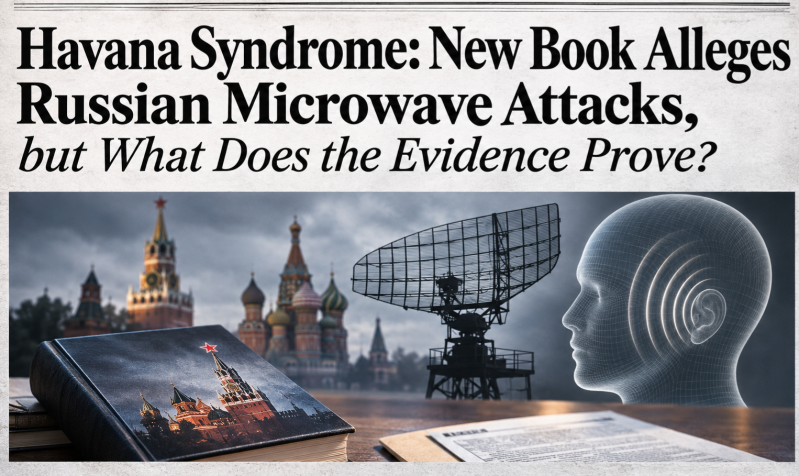
A new investigative book has renewed allegations that Russian intelligence operatives used directed-energy weapons against American diplomats and intelligence officers, while elements of the US government concealed evidence of the attacks.
The Havana Syndrome: Secret Weapons, a Government Cover-Up, and the Greatest Spy Mystery of Our Time, by CBS 60 Minutes investigative producers Michael Rey and Oriana Zill de Granados, was published in the United States on 13 October 2026.
The authors present years of investigative reporting, witness testimony and alleged intelligence connections suggesting Russian involvement in unexplained health incidents.
However, there remains no publicly verified evidence conclusively demonstrating that Russia deployed microwave weapons against American personnel or that the CIA deliberately concealed proof of such attacks.
The Established Science: A Predominantly American History
The scientific history of microwave-induced auditory perception predates Havana Syndrome by approximately seven decades.
An early milestone dates to 1947, when personnel associated with Airborne Instruments Laboratory (AIL) in the United States reportedly observed auditory sensations during radar-related work.
American biophysicist Allan H. Frey subsequently conducted systematic investigations during the early 1960s, establishing that pulsed microwave radiation could produce perceived sounds without conventional acoustic transmission through the air.
The accepted mechanism involves rapid thermoelastic expansion generating microscopic pressure waves that stimulate the cochlea.
American research progressed further during the 1970s. Experiments by Joseph C. Sharp and Mark Grove, described by psychologist Don R. Justesen in 1975, demonstrated recognition of spoken digits encoded into microwave pulses. Historical investigations also explored recognisable pulse patterns, including Morse-code-style signalling.
These developments form part of a predominantly American research timeline extending from early radar observations through experimental microwave auditory communication.
Soviet researchers also investigated microwave-induced auditory effects, including experiments reported by Tyazhelov and colleagues in 1979.
Their research involved controlled laboratory arrangements, including waveguides and water-based experiments, rather than portable pulsed transmitters capable of targeting individuals at a distance. These studies did not demonstrate intelligible speech transmission, Morse code or an operational long-range weapon.
American bioelectromagnetics researcher James C. Lin maintained professional relationships with Soviet scientists, helped interpret and communicate their research to Western scientific audiences, and reportedly remained friends with some of the researchers.
The Soviet investigations therefore formed part of a wider international scientific exchange, drawing upon earlier American discoveries, rather than demonstrating an independently developed operational microwave weapon.
A laboratory waveguide experiment is not equivalent to demonstrating a compact, remotely operated transmitter capable of attacking an individual at a distance.
Havana Syndrome: What Is Actually Known?
Beginning in Cuba in 2016, American diplomatic and intelligence personnel reported unusual auditory sensations, dizziness, headaches, cognitive difficulties and other health problems.
Some individuals experienced persistent and disabling symptoms.
A 2024 investigation by the US National Institutes of Health found no consistent group-level evidence of MRI-detectable brain injury or significant biological abnormalities distinguishing affected personnel from comparison groups.
These findings do not invalidate reported symptoms, but they do not support claims of a single identifiable form of neurological injury.
Scientific advisers have nevertheless considered directed, pulsed radiofrequency energy a plausible explanation for certain reported acute symptoms.
The US National Academies reached that assessment in 2020, while a separate expert panel considered external energy exposure plausible for some incidents in 2022.
Russian Intelligence and the Suspected Microwave Device
The new book highlights allegations involving Russian military intelligence Unit 29155, drawing on reported geographical overlaps, intelligence activity and accounts from affected personnel.
These connections warrant investigation but remain circumstantial. No publicly authenticated evidence establishes that Russian operatives deployed a microwave weapon during a specific Havana Syndrome incident.
Separate reporting in 2026 described American authorities acquiring a suspected directed-energy device reportedly connected to a Russian criminal network.
The apparatus has reportedly undergone classified testing, but its technical specifications, independently verified capabilities and connection to any reported incident have not been publicly established.
The suspected device may represent a modern, miniaturised application of established American pulsed-microwave technology, rather than an entirely new invention. US experiments demonstrated microwave-induced auditory effects and encoded speech transmission decades ago. However, the device's precise capabilities and any connection to Havana Syndrome remain unverified.
Even confirmation that such a device exists would not establish who developed it, whether it was operationally deployed or whether it caused the reported injuries.
Was There an Intelligence Cover-Up?
The book also alleges that elements of the CIA dismissed or concealed evidence of foreign involvement.
There have been documented disagreements between intelligence agencies, scientific advisers and affected personnel.
American intelligence assessments have generally considered foreign involvement unlikely, although individual agencies have expressed different confidence levels and some have remained open to alternative explanations.
Recent reporting indicates that earlier assessments were rescinded amid criticism of their analytical methods.
However, withdrawing an assessment does not establish that its conclusions were false or prove an alternative explanation.
There is evidence of institutional disagreement and criticism of investigative procedures, but no publicly demonstrated proof of a deliberate cover-up of confirmed Russian attacks.
What Does the Evidence Ultimately Establish?
The historical record supports several important conclusions.
Microwave-induced auditory perception is established science. American research documented the phenomenon and subsequently demonstrated recognisable encoded auditory communication through pulsed electromagnetic energy.
Soviet investigations contributed to the scientific literature but did not demonstrate the same encoded communication capabilities or an operational portable weapon capable of remotely producing neurological injuries.
Havana Syndrome symptoms are genuine reports requiring serious investigation, while the causes of individual incidents remain disputed.
The new book presents potentially significant investigative allegations, but its central claims concerning Russian responsibility and an American intelligence cover-up remain unproven.