

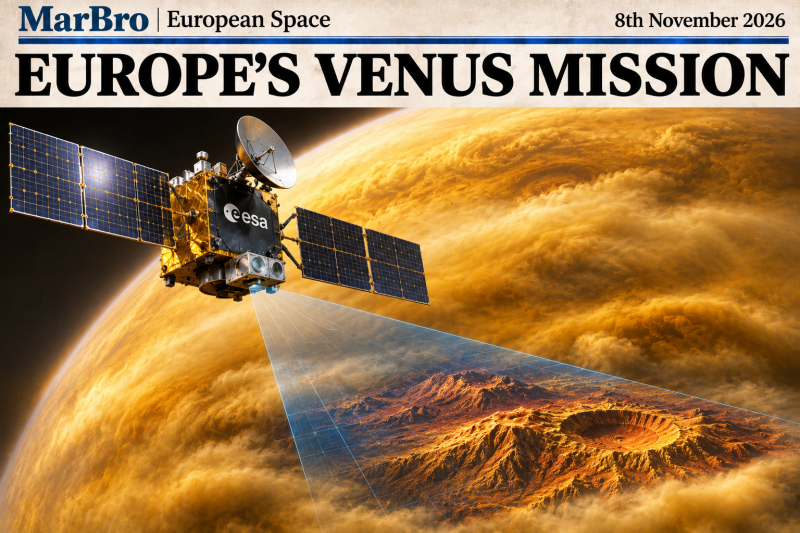
Europe's Venus Mission Could Reveal Why Earth's Neighbour Became Uninhabitable
European Space | 8th November 2026
Europe is preparing an ambitious mission to Venus that could help scientists understand why a planet similar in size to Earth became one of the most hostile environments in the Solar System.
The European Space Agency's EnVision spacecraft will investigate Venus from its upper atmosphere to its deep interior, searching for evidence of geological activity, ancient water and the processes that transformed its climate.
Although Venus and Earth share similar dimensions and rocky compositions, their environments are dramatically different. Venus has surface temperatures of approximately 465°C, crushing atmospheric pressure and an atmosphere dominated by carbon dioxide.
Scientists are investigating whether Venus once possessed liquid water and a more temperate climate before undergoing extreme greenhouse warming. However, its early environmental history remains uncertain.
Looking Beneath the Clouds
EnVision will carry instruments capable of penetrating Venus's thick clouds, mapping its surface and investigating geological structures beneath the ground.
Its radar systems are designed to reveal surface features, while spectrometers will examine atmospheric gases and investigate possible volcanic activity.
A subsurface radar sounder will probe geological structures as deep as one kilometre, potentially revealing evidence of ancient processes hidden beneath the planet's surface.
Together, these observations could help establish whether Venus remains geologically active and how its interior has influenced its atmosphere.
Britain and Europe's Role
The spacecraft is being developed under European leadership, with British scientists and engineers contributing to the mission.
In September 2026, reports revealed that uncertainty surrounding NASA's planned radar contribution had prompted ESA to investigate European-built alternatives.
Industrial teams in Britain and Italy began studying replacement radar designs, potentially strengthening Europe's technological independence while preserving EnVision's scientific objectives.
ESA's published mission information continues to list November 2031 as the planned launch date, although reporting in September indicated that a delay to 2032 was being considered to accommodate the European radar development.
By investigating how Venus evolved so differently from Earth, EnVision could improve our understanding of planetary habitability and help scientists assess the conditions that allow rocky planets to retain environments suitable for life.