

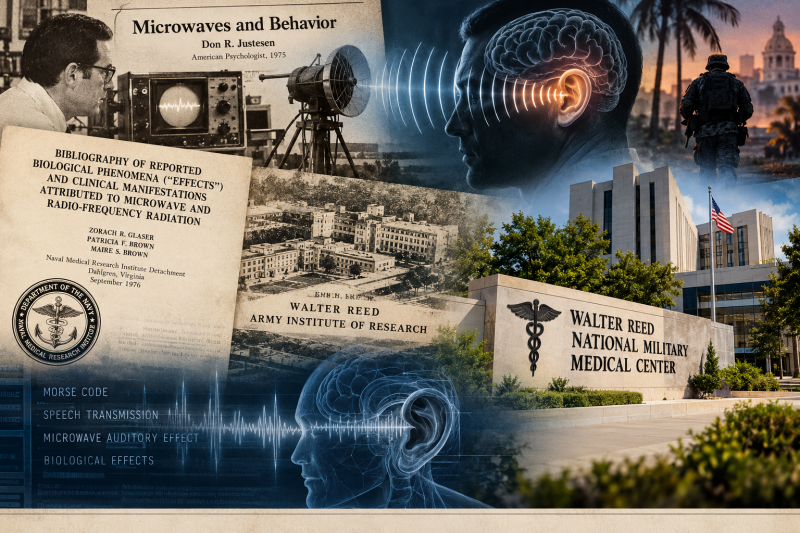
Walter Reed, Microwave Hearing and Havana Syndrome: A 50-Year Historical Connection
28 October 2026 | Science & Technology
Recent reports of new suspected Havana Syndrome cases receiving treatment at Walter Reed National Military Medical Center in Bethesda, Maryland, reveal an interesting historical connection with US military research into microwave auditory perception, speech transmission and biological effects dating back more than 50 years.
The Frey Effect and Microwave Hearing
During the early 1960s, American biophysicist Allan H. Frey demonstrated that appropriately pulsed microwave radiation could produce audible sensations, including clicking, buzzing and knocking, without conventional sound waves entering the ear.
Known as the Frey effect, or microwave auditory effect, this phenomenon occurs when absorbed electromagnetic pulses produce tiny thermoelastic pressure waves that stimulate the auditory system.
The discovery prompted further investigations into whether microwave pulses could transmit recognisable information, including speech.
Don R. Justesen and Speech Transmission — 1975
In March 1975, psychologist Don R. Justesen published Microwaves and Behavior in the journal American Psychologist.
His paper described experiments by Joseph C. Sharp and Mark Grove at the Walter Reed Army Institute of Research.
Using recorded speech converted into precisely timed microwave pulses, the researchers demonstrated that listeners could recognise spoken words through the microwave auditory effect.
Sharp reportedly distinguished nine single-syllable words representing digits. The perceived speech resembled that produced by an artificial larynx.
Justesen also discussed Arthur W. Guy's experiments transmitting Morse code through microwave pulses.
These experiments demonstrated that pulsed microwave radiation could convey recognisable auditory information without conventional loudspeakers or acoustic receivers.
Zory Glaser and the Browns — 1971–1976
During the same period, US Navy researcher Zorach R. Glaser was compiling extensive scientific evidence concerning microwave and radio-frequency biological effects.
Working with Patricia F. Brown and Maire S. Brown, Glaser produced an expanded bibliography in September 1976 containing more than 3,700 references.
The report, Bibliography of Reported Biological Phenomena (“Effects”) and Clinical Manifestations Attributed to Microwave and Radio-Frequency Radiation, documented research into neurological, physiological, behavioural and other reported biological responses.
Their work was produced through the Naval Medical Research Institute Detachment at Dahlgren, Virginia, within the US Navy's medical research system associated with Bethesda, Maryland.
The Walter Reed Connection
In 2011, the National Naval Medical Center in Bethesda became Walter Reed National Military Medical Center, incorporating functions transferred from Walter Reed Army Medical Center in Washington, DC.
This brought together the historical Army and Navy medical institutions associated with the earlier research.
The connections are particularly noteworthy:
- 1960s: Allan Frey establishes the microwave auditory effect.
- 1975: Justesen documents microwave-mediated speech and Morse-code transmission, including experiments associated with Walter Reed Army Institute of Research.
- 1976: Glaser and the Browns publish their extensive US Navy bibliography on microwave biological effects.
- 2011: Army and Navy medical services are consolidated at Walter Reed in Bethesda.
- 2026: Walter Reed reportedly treats additional patients experiencing symptoms associated with Havana Syndrome.
Havana Syndrome — October 2026
On 26 October 2026, investigative journalist Catherine Herridge reported at least six new suspected Havana Syndrome cases receiving treatment at Walter Reed.
Some reportedly involved individuals associated with directed-energy projects.
The reports have renewed interest in the military medical institution's historical relationship with electromagnetic radiation research.
Dr Len Ber, a physician advocating for civilians reporting anomalous health incidents, has also highlighted the importance of medical recognition, neurological assessment and access to specialist treatment.
Five Decades of Microwave Research
The historical connection between microwave research and Walter Reed spans more than five decades.
From Allan Frey's discovery of microwave hearing and Justesen's documentation of speech transmission to Glaser and the Browns' extensive naval research bibliography, the US military medical research system played an important role in investigating electromagnetic interactions with biological systems.
The latest Havana Syndrome reports bring renewed attention to this scientific history and the institutions involved.